Text Expansion Best Practices: Naming, Organization, and Workflow Tips
A text expander is only as useful as the snippets inside it. Start with five snippets and everything feels simple. Grow to 100 and suddenly you cannot remember which abbreviation does what, duplicates appear, and half your library goes unused. This guide covers the best practices that keep your snippet library clean, fast, and genuinely useful as it scales.
Start With High-Frequency Text
The biggest mistake new text expander users make is creating snippets for everything at once. Instead, pay attention to what you actually type repeatedly over the next week. When you catch yourself typing the same thing for the third time, that is your signal to create a snippet.
High-value targets include:
- Email greetings and closings
- Your address, phone number, and other personal details
- Common responses to frequently asked questions
- Code boilerplate you write daily
- URLs you share regularly
- Standard meeting agendas
In TypeFire, creating a snippet takes seconds. The habit of "I just typed this again, let me save it" is worth more than any pre-planned library.
Develop a Consistent Naming Convention
Your snippet names should tell you exactly what a snippet does without opening it. Compare these two approaches:
Bad names:
- "Email 1"
- "Response"
- "Code thing"
- "New snippet"
Good names:
- "Follow-up after demo call"
- "Support - refund policy explanation"
- "Python - logging boilerplate"
- "Meeting notes template - weekly standup"
A good naming pattern is: [Context] - [Specific description]
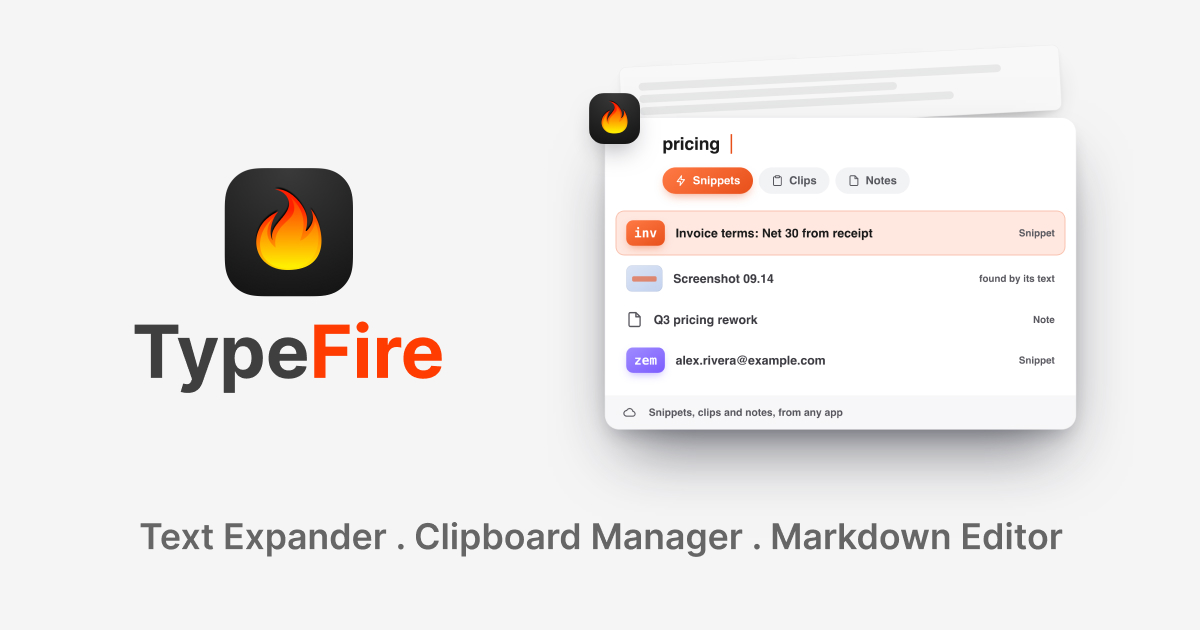
This makes search and scanning fast. When you open TypeFire's launcher and start typing, descriptive names surface the right snippet immediately.
Choose Abbreviations Deliberately
Abbreviations are the triggers you type to expand a snippet. They need to be:
- Unique - No conflicts with real words or other abbreviations
- Memorable - You should recall them without looking them up
- Fast to type - Short and easy on the fingers
The most popular approach is a prefix system. Pick a character you rarely type naturally and use it to start every abbreviation:
- Semicolon prefix:
;sig,;addr,;ty - Z prefix:
zsig,zaddr,zty - Double letter prefix:
;;sig,..addr
For a deep dive on this topic, read our abbreviation naming conventions guide.
Organize Collections by Context
Collections in TypeFire work like folders. The key is organizing by how you think about your snippets, not just by topic.
By use context:
- Work Email
- Personal Email
- Code - JavaScript
- Code - Python
- Support Responses
- Meeting Templates
By frequency:
- Daily Drivers (top 10-15 snippets)
- Weekly (used a few times a week)
- Reference (rarely triggered but important to have)
Most people find context-based organization more intuitive. When you think "I need that support response," you know exactly which collection to look in.
Avoid creating too many collections upfront. Start with three to five and split them as they grow. A collection with 50 snippets is a sign it should be broken into sub-collections.
Use TypeFire's Launcher for Discovery
Not every snippet needs an abbreviation. TypeFire includes a Spotlight-style launcher that lets you search your entire library by name or content. This is perfect for snippets you use occasionally.
Reserve abbreviations for your top 20-30 most-used snippets. Everything else can live in your library and be accessed through the launcher when you need it. This keeps your mental load low and avoids abbreviation conflicts.
Maintain Your Library Regularly
A snippet library is like a garden - it needs periodic maintenance.
Monthly review (5 minutes):
- Scan for snippets you have not used in months
- Archive or delete anything obsolete
- Check for duplicates
- Update any content that has changed (new phone number, updated company address, revised policies)
Quarterly cleanup (15 minutes):
- Review your collection structure
- Merge similar collections that have too few items
- Split collections that have grown too large
- Standardize naming across the library
TypeFire makes this easy because everything is visible in one place. A quick scroll through your library will surface anything that needs attention.
Write Snippets for Expansion, Not Storage
A common trap is using your text expander as a note-taking app. Snippets should be text you insert into other contexts, not text you just want to remember.
Good snippet content is:
- Ready to send - Minimal editing needed after expansion
- Generic enough to reuse - If you customize it heavily every time, it is not saving you time
- Current - Outdated snippets are worse than no snippets
If a snippet requires you to edit three paragraphs after every expansion, either break it into smaller focused snippets or use dynamic tokens to handle the variable parts.
Leverage Dynamic Tokens
TypeFire supports dynamic tokens that make your snippets smarter without making them more complex.
Practical examples:
- Date insertion: "Meeting Notes - {date}" gives you a fresh date every time
- Clipboard integration: "Here is the link you requested: {clipboard}" grabs whatever URL you just copied
- Time stamps: "Logged at {time} on {date}" for consistent record-keeping
Tokens turn a static snippet into a dynamic template. A single "meeting notes" snippet with a {date} token replaces the need to update the date manually every time.
Build Workflows, Not Just Snippets
The most productive TypeFire users think in workflows, not individual snippets. For example, a customer support workflow might include:
;greet- Opening greeting;ack- Acknowledgment of the issue;resolve- Resolution steps;close- Closing and follow-up
These four snippets, used together, let you handle a complete support interaction in a fraction of the time. Group them in a "Support Flow" collection so they are easy to find and maintain together.
Avoid These Common Mistakes
Too many abbreviations: If you have 200 abbreviations, you will not remember most of them. Be selective.
Abbreviations that are too similar: ;em1 and ;em2 will cause confusion. Use descriptive triggers like ;emfollow and ;emintro.
Never updating content: An email signature snippet from six months ago probably has the wrong job title. Review regularly.
Overcomplicating structure: Three levels of nested collections is usually the maximum before navigation becomes slower than searching.
Not using the launcher: The launcher exists so you do not have to memorize every abbreviation. Use it.
Getting Started
If you are new to TypeFire, check out our setup guide to get installed and running. If you are coming from another tool, our TextExpander migration guide walks through the transition step by step.
The best snippet library is one you actually use. Start small, stay consistent with naming, and maintain it regularly. Within a few weeks, you will wonder how you ever worked without it.
Templates you might want
- Expansion Opportunity Messages: Customer Success
- Wellness Tips and Guides: Fitness & Wellness
- Email Signatures: Personal Productivity
- Quick Reply Templates: Personal Productivity
Loved by people who type all day.
Unprompted reactions from users, in their own words.
Used by people at
Company names are places where our users work. They do not imply endorsement or affiliation.