TypeFire vs aText: Two Mac Text Expanders Compared
aText has been a favorite budget text expander on the Mac for years, and it still is. It is cheap, it is fast, and it is still updated: the Mac version had a release in July 2024. It also runs on Windows.
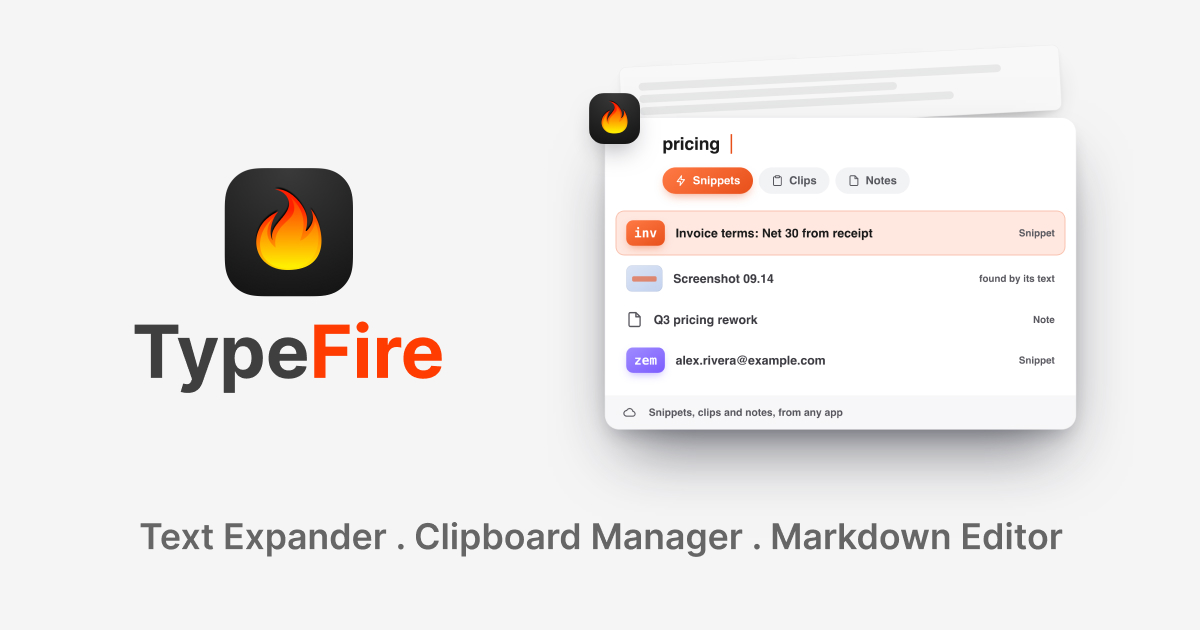
TypeFire is free, and it puts a text expander, a Markdown notes app and a clipboard manager in one Mac app. Here is how the two compare.
Price
aText costs $4.99, and that buys one year. A lifetime license is $29.99, and there is a 21-day trial. Either way it is one of the cheapest paid text expanders around.
TypeFire's text expander is free with unlimited snippets, and it stays free. Pro is optional: $18 once, for unlimited clipboard history, Selection Prompts, Prompt Chains, notes sync and note version history. There is no subscription.
Snippets
Both apps do the core job well. You type an abbreviation and the full text drops in, in any app. Both handle rich text and pictures, both insert dates and ask for fill-in values, and both run scripts (aText runs AppleScript and shell scripts; TypeFire runs JavaScript and AppleScript).
Where TypeFire goes further is Markdown. You can write a snippet in Markdown and it pastes as formatted text in apps that take it, or as plain Markdown where that is what the app wants. The editor shows a live preview.
For example, a meeting notes template in TypeFire might look like:
## Meeting Notes - {date}

**Attendees:**
-

**Agenda:**
1.

**Action Items:**
- [ ]

**Next Meeting:**
This expands as formatted text in any app that supports it.
AI in your snippets
TypeFire snippets can carry AI. Put {{ai:rewrite}} or {{ai:translate:fr}} in a snippet and it runs as it expands, on Apple Intelligence or with your own key for Claude, OpenAI or Gemini. Selection Prompts go one step further: select text in any app, press the prompt's shortcut, and the answer replaces your selection.
Sync
aText syncs through a cloud folder you choose: iCloud Drive, Dropbox, Google Drive, OneDrive or a shared network folder. TypeFire syncs over your own iCloud, built in, with nothing to set up beyond turning it on.
More than a text expander
This is the real difference. TypeFire is also:
- A clipboard manager. Everything you copy stays searchable, screenshots included, by the words inside them.
- A Markdown notes app. Point it at any folder of
.mdfiles, including an Obsidian vault, and it opens them in place with wikilinks, backlinks, tabs and a graph. - One Spotlight for all three. One shortcut searches your snippets, notes and clips from any app.
With aText you would add a separate clipboard manager and a separate notes app.
Switching
Moving from aText takes a few minutes for a typical library:
- Export your snippets from aText as a CSV file.
- Import that file in TypeFire's settings.
- Try your most-used abbreviations to confirm they work.
- Remove aText from your login items.
Who should stick with aText?
aText is a good pick if you need the same text expander on Windows and on a Mac, or if a single low-cost license and a lean app are all you want.
Who should use TypeFire?
TypeFire is the better choice if:
- You want unlimited snippets without paying every year
- You want Markdown snippets and AI inside your snippets
- You want Markdown notes and a clipboard manager in the same app
- You want sync over iCloud with nothing to set up
The bottom line
aText is honest value for a classic text expander. TypeFire gives you that job for free, then adds AI, Markdown, clipboard history and notes in the same app.
Also in Chrome: TypeFire for Chrome brings snippets, Markdown notes and clips to any browser, on Windows, Linux and Chromebook too, with the same sign-in as the Mac app. Install it from the Chrome Web Store or read about TypeFire for Chrome.
For a comparison of all the major text expanders, see our best text expander for Mac in 2026 roundup.
Templates you might want
- Email Signatures: Personal Productivity
- Quick Reply Templates: Personal Productivity
- Rewrite & Polish: AI Workflows
- Failed Payment Response: Customer Support
Loved by people who type all day.
Unprompted reactions from users, in their own words.
Used by people at
Company names are places where our users work. They do not imply endorsement or affiliation.