TypeFire vs Espanso: Native GUI vs Command Line
TypeFire and Espanso are both free text expanders, which already sets them apart from most of the competition. But they take fundamentally different approaches to the same problem. TypeFire is a native Mac app with a graphical interface. Espanso is a cross-platform command-line tool configured through YAML files.
Which one you should use depends entirely on how you like to work.
The core difference: GUI vs CLI
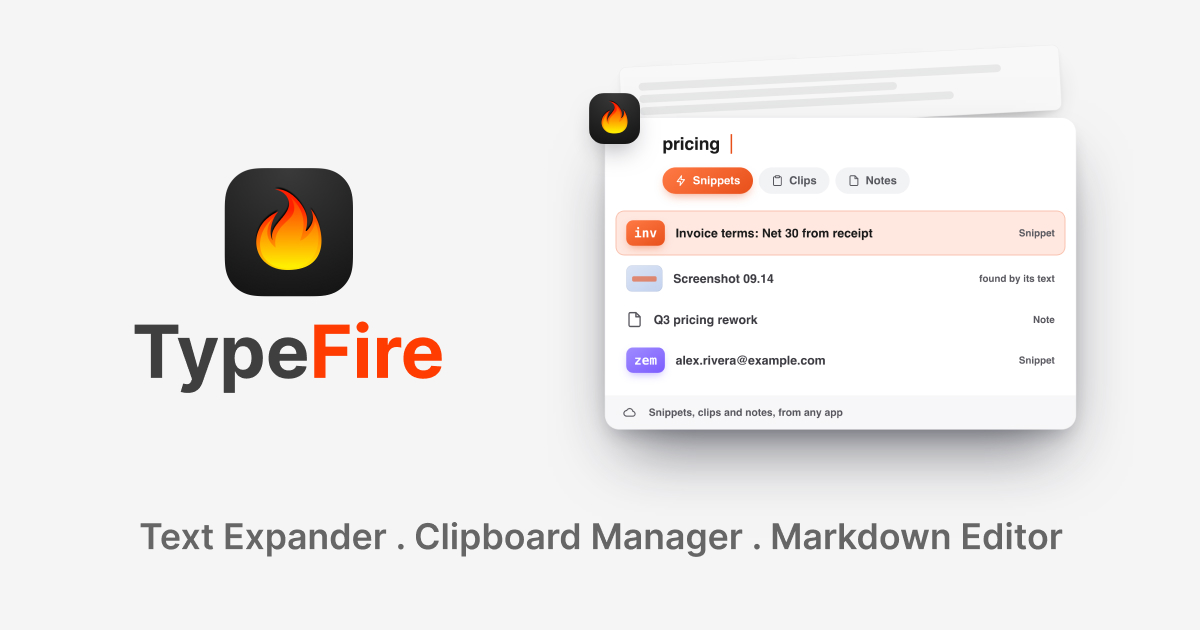
TypeFire gives you a visual snippet editor, a menu bar app, searchable collections, and point-and-click management. You create a snippet by opening the app, clicking "new snippet," typing your abbreviation and content, and saving.
Espanso gives you a YAML configuration file. You create a snippet by opening a text file and writing something like:
matches:
  - trigger: ";sig"
    replace: |
      Best regards,
      Jane Smith
      Senior Developer
      jane@example.com
Both approaches work. The question is which one fits your brain and your workflow.
Who Espanso is built for
Espanso is built for developers and power users who are already comfortable in the terminal. If you spend your day in VS Code, iTerm, and vim, editing a YAML file to add a snippet feels completely natural. Espanso's config-file approach also means your snippets can live in a git repository, giving you version control and easy sharing.
Espanso also runs on Linux, Windows, and Mac. If you work across multiple operating systems, Espanso is one of the very few free options that follows you everywhere.
The tool is open source and extensible. There is a package system (Espanso Hub) where the community shares snippet packs - collections of common expansions for specific use cases like email, dates, or emoji.
Who TypeFire is built for
TypeFire is built for Mac users who want text expansion to just work without touching config files. If you would rather click a button than edit YAML, TypeFire is your tool.
The app is native macOS - it runs natively on Apple Silicon, and follows Mac design conventions. Creating, editing, and organizing snippets all happen through a clean visual interface. You do not need to know what YAML is.
TypeFire also supports Markdown for snippet formatting, which means your expansions can include headers, bold text, lists, and code blocks. The editor shows a live preview so you can see exactly what your snippet will look like.
Feature comparison
Snippet types
Espanso supports plain text replacement, shell command output, date/time tokens, clipboard content, cursor positioning, regex triggers, and more. Its extension system lets you pull in weather data, random text, and other dynamic content.
TypeFire supports Markdown-formatted text, date/time tokens, clipboard content, and other dynamic tokens. It focuses on the most common use cases and handles them well through a visual interface.
Espanso has more raw power. TypeFire has more polish.
Organization
Espanso organizes snippets across multiple YAML files. You can create separate files for different categories - email.yml, code.yml, support.yml - and Espanso loads them all automatically.
TypeFire uses collections - visual folders that group related snippets together. You can search across all collections or browse them individually.
Sync
Espanso does not have built-in sync. Since its config is just files, you can sync them with Dropbox, Google Drive, or git. This is flexible but requires manual setup.
TypeFire syncs through iCloud automatically. No setup, no third-party services - your snippets appear on every Mac signed into the same iCloud account.
Expansion reliability
Both apps use system-level text insertion to expand snippets. In practice, both work reliably across most applications. Espanso occasionally has issues with certain Electron apps. TypeFire uses the macOS accessibility API, which is well-supported across native and web apps.
Setup and maintenance
Espanso requires Homebrew or manual installation, followed by configuration file setup. Updating means running brew upgrade espanso or downloading a new release manually.
TypeFire installs like any Mac app - drag to Applications and launch. Updates happen automatically through the Mac App Store or built-in updater.
Practical examples
Here is how you would create a snippet that inserts a formatted date in both tools:
Espanso (in ~/.config/espanso/match/base.yml):
matches:
  - trigger: ";today"
    replace: "{{mydate}}"
    vars:
      - name: mydate
        type: date
        params:
          format: "%B %d, %Y"
TypeFire (in the visual editor):
- Abbreviation:
;today - Content:
{date}(using the built-in date token)
Both accomplish the same thing. Espanso gives you more control over the format. TypeFire gets you there faster.
Performance
Both apps are lightweight. Espanso runs as a background process using minimal memory. TypeFire sits in your menu bar with a similarly small footprint. Neither will slow down your Mac.
The honest take
If you are a developer who lives in the terminal and works across Mac, Linux, and Windows - use Espanso. It is free, open source, and incredibly powerful once you learn the configuration system.
If you are a Mac user who wants text expansion without a learning curve - use TypeFire. It is also free, with a clean native interface and zero configuration files to manage.
Also in Chrome: TypeFire for Chrome brings snippets, Markdown notes and clips to Linux and Windows for anyone whose day is mostly in a browser. Espanso still covers the terminal and native apps there, and a common setup is Espanso for the terminal and TypeFire for the browser. Install it from the Chrome Web Store or read about TypeFire for Chrome.
There is no wrong choice here. Both are free, both work well, and both save you time. The difference is purely in how you prefer to interact with your tools.
Can you use both?
Technically yes, but you probably should not. Running two text expanders at the same time can cause conflicts where both try to expand the same abbreviation. Pick one and commit to it.
If you are unsure which fits better, try TypeFire first - it takes about two minutes to install and create your first snippet. If you find yourself wanting config files and regex triggers, switch to Espanso.
For a comparison with other alternatives, see our best text expander for Mac in 2026 roundup.
Templates you might want
- Email Signatures: Personal Productivity
- Quick Reply Templates: Personal Productivity
- Rewrite & Polish: AI Workflows
- Failed Payment Response: Customer Support
Loved by people who type all day.
Unprompted reactions from users, in their own words.
Used by people at
Company names are places where our users work. They do not imply endorsement or affiliation.