Canned Responses on Mac: Set Up Once, Use Everywhere
Canned responses are pre-written replies that you can send with minimal modification. Most people associate them with customer support tools like Zendesk or Intercom, but the concept works for anyone who answers similar questions repeatedly - sales teams, HR, freelancers, managers, or anyone who handles a high volume of email.
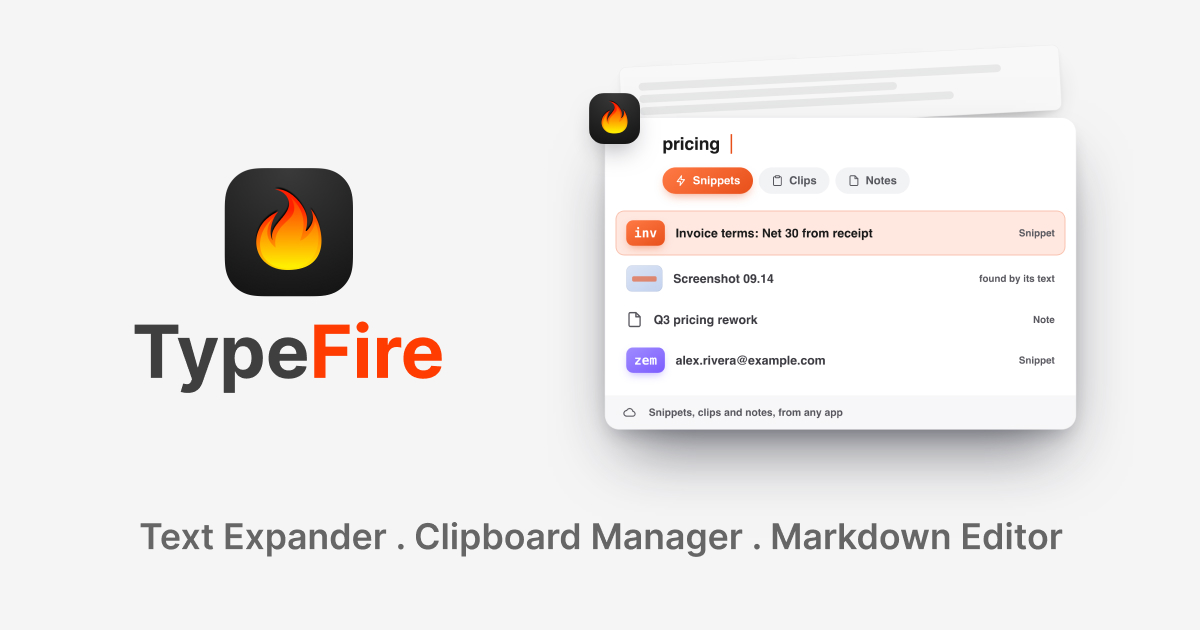
The problem with canned responses built into specific tools is that they only work in that tool. Your Zendesk macros do not help when you are replying in Gmail. Your Gmail templates do not work in Slack. TypeFire solves this by giving you canned responses that work in every application on your Mac.
Why System-Wide Canned Responses Matter
Think about where you answer repetitive questions:
- Email (Gmail, Outlook, Apple Mail)
- Slack or Teams
- Customer support tools
- Social media DMs
- CRM platforms
- Project management tools (Jira, Linear, Asana)
- Live chat widgets
Each of these might have its own template system, or it might have none at all. Maintaining separate template libraries across five different tools is a recipe for inconsistency and wasted time.
With TypeFire, you maintain one library that works everywhere. Type your abbreviation in any text field on your Mac and your canned response appears instantly.
Building Your Canned Response Library
Start by Auditing Your Sent Messages
Before creating snippets, spend 15 minutes reviewing your sent emails and messages from the past week. Look for:
- Messages you sent more than twice with similar content
- Replies where you copied text from a previous message
- Responses that follow a predictable structure
- Information you type out repeatedly (pricing, policies, directions)
Most people discover 10 to 15 canned response candidates in the first audit.
Customer Support Responses
Acknowledgment (;csack):
Thank you for reaching out. I have received your message and will look into this right away.

I will follow up with a detailed response within [timeframe]. If you need immediate assistance in the meantime, please [alternative contact method].
Feature request acknowledgment (;csfeature):
Thank you for the feature suggestion. I have added your request to our product feedback tracker.

While I cannot guarantee a timeline for implementation, your input directly influences our roadmap priorities. I will let you know if this feature moves into active development.

Is there anything else I can help you with?
Bug report follow-up (;csbug):
Thank you for reporting this issue. I have been able to reproduce it on our end and have escalated it to our engineering team.

Here is what we know so far:
- Issue:
- Status: Under investigation
- Workaround:

I will update you as soon as we have a fix. Thank you for your patience.
Refund/cancellation (;csrefund):
I have processed your request. Here are the details:

- Reference number:
- Amount:
- Expected processing time:

You should see this reflected in your account within [timeframe]. Please let me know if you have any questions or if there is anything else I can help with.
Sales Responses
Initial inquiry response (;sinquiry):
Thank you for your interest in [product/service]. I would be happy to help you find the right solution.

To make sure I point you in the right direction, could you share:
1. What problem are you looking to solve?
2. What is your team size?
3. What is your timeline for making a decision?

I am available for a quick call this week if you would prefer to discuss in person. Here is my calendar: [link]
Follow-up after demo (;sdemo):
Great speaking with you today. As discussed, here is a summary:

Key points covered:
-
-
-

Next steps:
1.
2.

I have attached [relevant materials]. Let me know if you have any questions or if there is anything else you would like to explore.
Pricing question (;spricing):
Great question. Here is a breakdown of our pricing:

[Pricing details]

This includes:
-
-
-

I am happy to set up a call to discuss which option makes the most sense for your team. Would [date/time] work?
HR and Internal Communication
Interview scheduling (;hrinterview):
Thank you for your application for the [position] role. We would like to invite you to interview with our team.

Interview Details:
- Date:
- Time:
- Duration: [minutes]
- Format: [In-person / Video call]
- Location/Link:

Please confirm your availability at your earliest convenience. If the proposed time does not work, please suggest alternatives and we will do our best to accommodate.

We look forward to speaking with you.
PTO acknowledgment (;hrpto):
Your time off request has been received and approved.

Details:
- Dates: [start] to [end]
- Type: [Vacation / Sick / Personal]
- Return date:

Please make sure to update your calendar and set up any necessary out-of-office replies before your leave. Let me know if you need anything else.
Everyday Email Responses
Meeting request (;mtgreq):
I would like to schedule some time to discuss [topic]. Would any of the following work for you?

- [Day], [Time]
- [Day], [Time]
- [Day], [Time]

The meeting should take about [duration]. I will send a calendar invite once we confirm a time.
Thank you with next steps (;tynext):
Thank you for [context]. I appreciate your [time/help/input].

Here are the next steps:
1.
2.
3.

I will follow up by [date] with an update. Please let me know if anything changes on your end.
Polite decline (;decline):
Thank you for thinking of me. Unfortunately, I am not able to commit to this at the moment due to [brief reason].

I would suggest reaching out to [alternative] who might be a better fit for this.

I appreciate your understanding and hope we can collaborate on something in the future.
Making Canned Responses Feel Personal
The biggest concern with canned responses is sounding robotic. Here are techniques to avoid that:
Use Dynamic Tokens
TypeFire's dynamic tokens let you insert variable content. {{date}} adds today's date. {{clipboard}} inserts whatever you just copied - like a customer's name or issue description. {{cursor}} places your cursor where personalization is needed.
Design for Customization
Notice that the templates above have bracketed placeholders like [topic] and [timeframe]. These are intentional points where you pause and personalize. A good canned response is 80% template and 20% customization.
Write Naturally
Avoid corporate jargon in your templates. Write the way you would actually talk. Templates that sound like a human wrote them will still sound human after the hundredth use.
Organizing Your Library
TypeFire's collections let you group canned responses by purpose:
- Support - Customer-facing issue responses
- Sales - Inquiry responses, follow-ups, pricing
- Internal - HR, team communication, meeting scheduling
- Personal - Everyday email templates
Use a prefix system for abbreviations:
;csfor customer support;sfor sales;hrfor HR;mfor meetings
Or use TypeFire's spotlight launcher to search by keyword instead of memorizing abbreviations. Press Cmd+Ctrl+1, type "refund," and your refund response template appears.
Measuring the Impact
Track your usage for one week. Most professionals who set up a canned response library of 15 to 20 templates report saving 30 to 60 minutes per day. That is 2.5 to 5 hours per week - time that goes back into focused, high-value work.
TypeFire is completely free and runs natively on macOS. Set up your first five canned responses today and see the difference. Start with the messages you sent most often this past week. Within a few days, reaching for a canned response will be as natural as typing the reply yourself - just ten times faster.
Templates you might want
- Customer Service Responses: Banking & Finance
- QBR Templates: Customer Success
- Escalation Templates: Customer Success
- Failed Payment Response: Customer Support
Loved by people who type all day.
Unprompted reactions from users, in their own words.
Used by people at
Company names are places where our users work. They do not imply endorsement or affiliation.