Organizing Snippets with Collections: Build a System That Scales
Ten snippets need no organization. You remember them all and can find any one in seconds. Fifty snippets start to get unwieldy. A hundred snippets without a system is chaos - you know the snippet exists but you cannot find it, so you end up typing the text manually anyway.
This is the organization problem that kills most text expansion habits. People create snippets enthusiastically, hit a critical mass where finding them becomes harder than typing from scratch, and gradually stop using the tool.
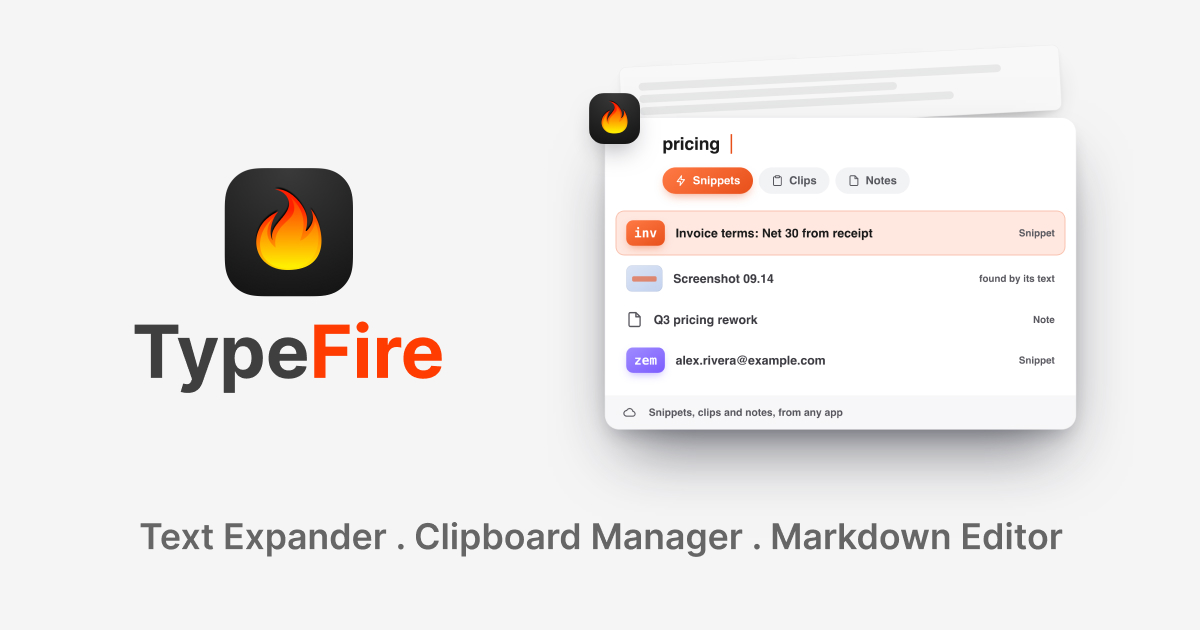
TypeFire's collections feature exists to prevent that. Here is how to build an organization system that works at 10 snippets and still works at 500.
What Collections Are
Collections in TypeFire are groups that contain related snippets. Think of them like folders, but more flexible. Every snippet belongs to a collection, and collections give your library a navigable structure.
Collections appear in TypeFire's sidebar, in the launcher search results, and as organizational context throughout the app.
The Two Organization Mistakes
Before talking about what works, here are the two patterns that do not:
Mistake 1: No Organization
Dumping every snippet into a single default collection. This works briefly and fails completely once you pass 20 to 30 snippets. Scrolling through an unsorted list to find one snippet is painful.
Mistake 2: Over-Organization
Creating a collection for every possible category, subcategory, and edge case. If you have 40 snippets across 25 collections, most collections contain one or two items. The overhead of choosing where to put each snippet and remembering where it lives outweighs any benefit.
The sweet spot is 4 to 8 collections for most people. Enough structure to be useful, few enough to remember without thinking.
Framework 1: Organize by Context
The most intuitive approach - group snippets by where or when you use them.
Example collections:
- Email - Signatures, templates, canned responses, follow-ups
- Code - Function templates, boilerplate, documentation blocks
- Meetings - Agendas, notes templates, follow-up messages
- Support - Customer responses, bug acknowledgments, FAQ answers
- Personal - Address, phone number, common personal messages
This works well when your snippets map cleanly to distinct activities. A designer might have Design, Handoff, Feedback, and Communication collections. A student might use Essays, Citations, Email, and Notes.
Framework 2: Organize by Frequency
Group snippets by how often you use them, not what they are about.
Example collections:
- Daily Drivers - The 10 to 15 snippets you use every single day
- Weekly - Templates for recurring weekly tasks
- Occasional - Useful but infrequent (quarterly reports, annual reviews)
- Reference - Snippets you rarely expand but want searchable (policy language, legal text)
This approach optimizes for speed. Your most-used snippets are in one small collection that you can scan quickly. Less-used snippets are available via search but do not clutter your daily view.
Framework 3: Organize by Role
If you wear multiple hats - especially common for founders, freelancers, and managers - organize by the role you are in when you use the snippet.
Example collections:
- Manager - One-on-one templates, feedback, performance reviews
- Developer - Code patterns, PR templates, technical documentation
- Sales - Outreach, follow-ups, proposals
- Admin - Invoices, contracts, scheduling
This makes context-switching easier. When you shift from coding to sales calls, you mentally switch to the Sales collection and your relevant snippets are right there.
Framework 4: Organize by Audience
Group snippets by who receives the text.
Example collections:
- Internal Team - Slack messages, status updates, meeting notes
- Clients - Proposals, updates, canned responses
- Public - Social media posts, documentation, marketing copy
- Personal - Family, friends, personal admin
This works especially well for roles that communicate with distinctly different audiences in different tones.
Building Your Collection Structure
Step 1: Audit Your Existing Snippets
If you already have snippets, review them. For each one, ask: "When do I use this?" The answer reveals natural groupings. If 15 snippets are all email-related, that is a collection.
Step 2: Start with 4 to 6 Collections
Resist the urge to create more. You can always split a collection later if it gets too large. Starting with too many collections creates decision fatigue ("does this go in Email or Communication or Client?").
Step 3: Name Collections Clearly
Use plain, descriptive names. "Email" beats "E-Comms." "Code" beats "Dev Stuff." When you are searching in the launcher, these names become search terms - make them words you would naturally type.
Step 4: Establish Abbreviation Prefixes
A consistent prefix system ties your collections to your abbreviations:
| Collection | Prefix | Example |
|---|---|---|
;e |
;esig, ;efollow, ;ereply |
|
| Code | ;c |
;cfunc, ;clog, ;cdoc |
| Meeting | ;m |
;magenda, ;mnotes, ;mfollow |
| Support | ;s |
;sack, ;sbug, ;sfeature |
This means even without the launcher, you can narrow down which snippet you want by typing the prefix and thinking within that collection's context.
When to Split a Collection
A collection is too large when you cannot scan its contents quickly - roughly 25 to 30 snippets. At that point, look for natural subdivisions.
For example, if your "Email" collection has 40 snippets, you might split it into:
- Email - Internal - Team messages, meeting scheduling
- Email - Client - Client communications, proposals
- Email - Support - Customer support responses
Or if your "Code" collection is overflowing:
- Code - Frontend - React, CSS, HTML patterns
- Code - Backend - API routes, database queries
- Code - DevOps - Docker, CI/CD, deployment
See our guides on code snippets and canned responses for more specific organizational patterns.
When to Merge Collections
If a collection has fewer than 3 to 5 snippets and has been that way for months, it is probably not a useful category. Merge it into a broader collection. A "Legal" collection with two snippets should probably join "Admin" or "Reference."
Collection Maintenance
Like any organizational system, collections need occasional maintenance:
Monthly Review (5 minutes)
- Scan each collection for snippets you no longer use
- Move snippets that landed in the wrong collection
- Check if any collection is getting too large
Quarterly Cleanup (15 minutes)
- Delete snippets you have not used in 3 months
- Review abbreviation prefixes for consistency
- Consider splitting or merging collections based on current usage
When You Change Roles or Projects
Major work changes are a natural time to reorganize. New project? New collection. Left a team? Archive their snippets. Added a new workflow? Create snippets and organize them immediately rather than dumping them in Default.
Collections and iCloud Sync
If you use iCloud Sync to share snippets across multiple Macs, your collection structure syncs too. Changes you make to collections on one machine - renaming, reorganizing, adding snippets - appear on all your synced devices.
This makes it especially important to maintain clean organization. A messy structure on one Mac becomes a messy structure everywhere.
The "Default" Collection
TypeFire includes a Default collection for snippets that do not have a specific home. This is fine for your first few snippets, but try to graduate them to proper collections as your library grows. A healthy library has a small or empty Default collection.
Real-World Examples
Freelance Designer
- Client Comms (12 snippets) - Proposals, updates, invoices
- Design (18 snippets) - Specs, feedback templates, handoff notes
- Admin (8 snippets) - Contracts, scheduling, personal info
- Social (6 snippets) - Portfolio posts, networking messages
Software Engineer
- Code (25 snippets) - Patterns, boilerplate, documentation
- Reviews (10 snippets) - PR comments, feedback templates
- Team (8 snippets) - Standup updates, meeting notes
- Quick (12 snippets) - Email address, links, short phrases
Customer Support Lead
- Responses (30 snippets) - Categorized customer replies
- Internal (10 snippets) - Escalation templates, team updates
- Reports (8 snippets) - Weekly summaries, metric templates
- Training (6 snippets) - Onboarding docs, process guides
Start Simple, Iterate
The best collection structure is the one you actually use. Start with 4 collections based on your gut instinct. Use them for two weeks. Then adjust based on what feels right and what feels wrong. Organization is personal - what works for a support team lead will not work for a freelance developer.
TypeFire makes reorganizing painless. Drag snippets between collections, rename collections, create new ones, merge old ones. Your abbreviations and shortcuts stay the same regardless of how you reorganize. The system is designed to evolve with you.
Templates you might want
- Brand Guidelines Snippets: Design & Creative
- Terms of Service Snippets: Legal & Compliance
- Email Signatures: Personal Productivity
- Quick Reply Templates: Personal Productivity
Loved by people who type all day.
Unprompted reactions from users, in their own words.
Used by people at
Company names are places where our users work. They do not imply endorsement or affiliation.