Obsidian alternative for Mac. Keep Obsidian. Give your vault a global hotkey.
Is TypeFire an Obsidian alternative, or can I run both?
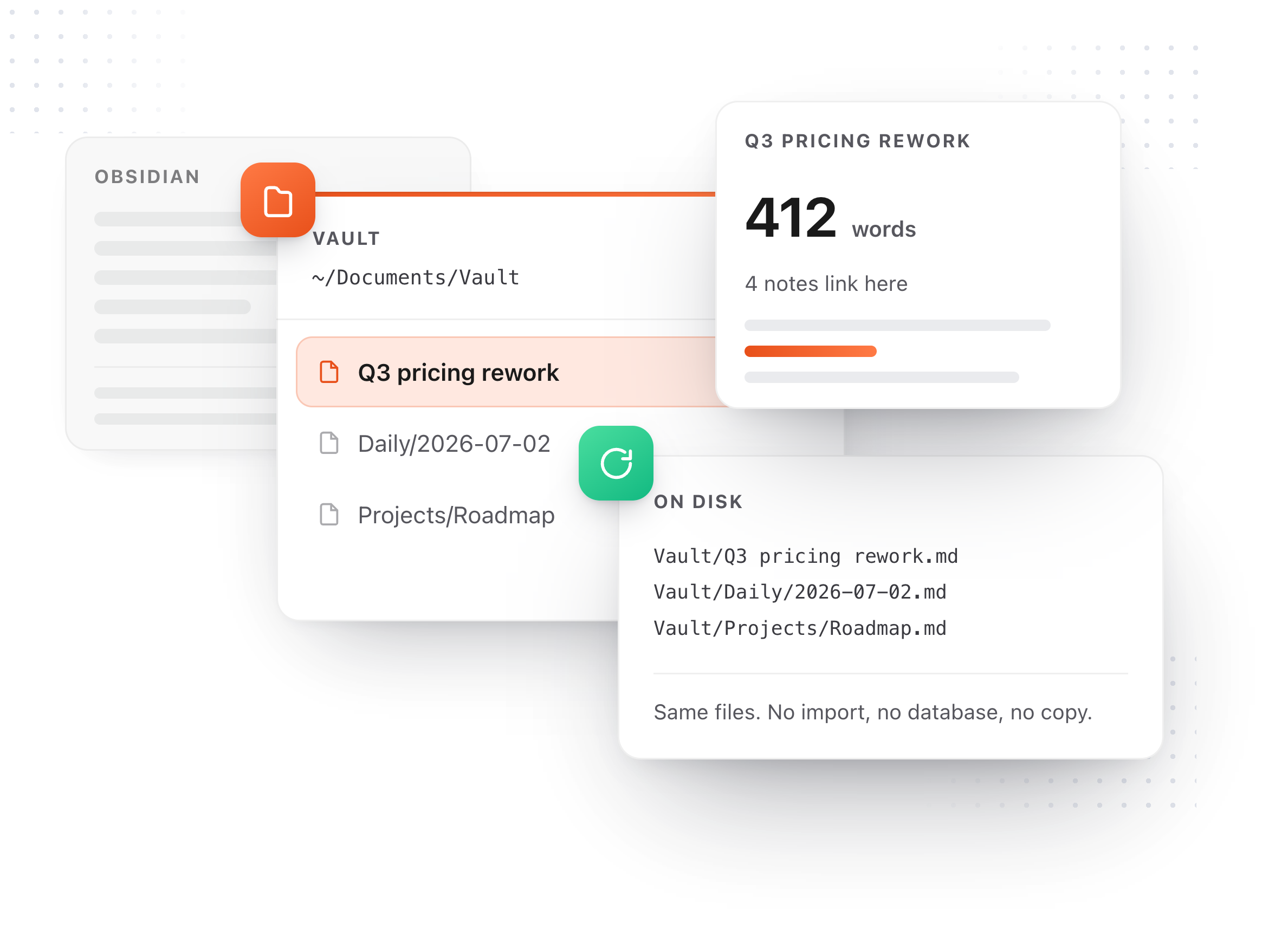
Both, and most people run both. TypeFire opens your existing Obsidian vault in place, with no import, no copy and no proprietary format, so the same markdown files stay exactly where they are.
Obsidian can be open on those files at the same time. Since 5.0 TypeFire also has its own graph view, free and always available.
What TypeFire adds to a vault you keep
Not reasons to leave Obsidian. Reasons to put a second, faster way in front of the same folder.
See how your vault connects, without setting anything up
TypeFire 5.0 draws every note, snippet and clip on one canvas, built from the links, tags and folders already in the vault Obsidian reads. It needs no model and no download, and it cannot be switched off. A connection you made is drawn solid and one TypeFire worked out is drawn dashed, so the two are never confused. Turn on Weave and search starts matching what you meant rather than the exact words you typed. Free, including for people who already bought.
Your vault, without opening Obsidian
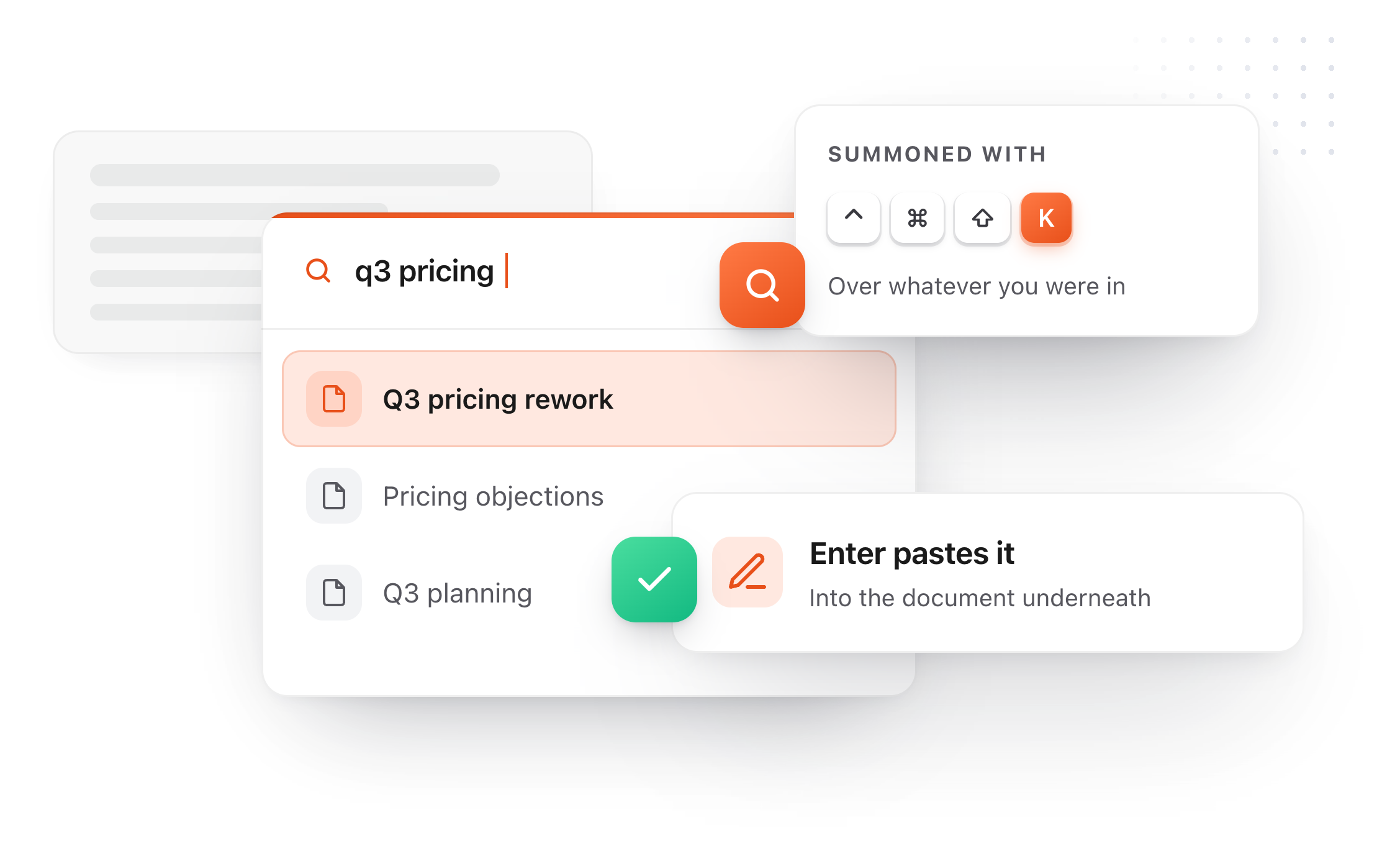
Press ⌘⌃3 in Mail, Slack, Xcode or Figma. Search every note, press Enter, and the text lands in the document you were already in. Escape returns you to the same cursor. Obsidian is a destination you switch to; this comes to you.
Capture without breaking flow
Quick capture is Obsidian's most-cited weak spot and needs plugins like QuickAdd to get sophisticated. The usual workaround is to route capture to Apple Notes and never reconcile the two inboxes. ⌘⌃⇧N writes straight into the vault Obsidian already reads, so there is nothing to reconcile.
Sync without a subscription
Obsidian Sync is $4 to $8 a month, forever. TypeFire Pro is $18 once and covers three Macs, and it carries notes sync, version history, the clipboard manager, Selection Prompts and Chains with it. A year of Obsidian Sync costs more than TypeFire Pro costs once.
Snippets that expand inside your notes
Type an abbreviation in a note and it expands, exactly as it does in every other app on your Mac. No note app has a text expander in it, and no text expander has notes. It runs both ways: a paragraph you keep rewriting becomes a snippet in one click.
Nothing to set up before you can write
The most repeated complaint about a fresh Obsidian vault is that it gives you nothing, and people report spending longer configuring than writing. TypeFire's onboarding seeds content and walks you through it, and pointing at an existing vault means your first screen is a full library rather than an empty one.
Point it at as many folders as you like, including a repo
Vaults are free and uncapped, switched from a dropdown above the folder list, and each one keeps its own daily-note format, default folder and version history. Point one at a git repository and nothing TypeFire creates ever turns up in git status, because the history and the search index are held outside the folder entirely.
Markdown renders in Finder
Press space on any .md file, including files inside your Obsidian vault, and read it rendered rather than as raw source. TypeFire registers a Quick Look extension for the whole Mac.
TypeFire compared with Obsidian
Prices and capabilities as of September 2026.
| TypeFire | Obsidian | |
|---|---|---|
| Reads an existing markdown vault | Yes, in place | Yes, it is the vault |
| Search notes from inside another app | Global hotkey overlay | No |
| Paste a note into the app you are in | Yes | Copy and switch |
| Quick capture | Built in, one hotkey | Plugins |
| Task lists and highlight | Yes, same syntax | Yes |
| Slash commands | Yes | Yes |
| Callouts, footnotes, folding | Yes, same syntax | Yes |
| Tables edited in place | Grips, menus, paste a spreadsheet | Yes |
| Text expander in your notes | Yes | No |
| Notes sync | $18 once, 3 Macs | $4 to $8 per month |
| Version history | Included in Pro | Included in Sync |
| Clipboard manager | Yes, with OCR search | No |
| MCP for AI apps | Built in, Obsidian can be closed | Community plugin, API key, open |
| Commercial use | No extra license | $50 per user per year |
| Platforms | Mac, plus a Chrome extension | Mac, Windows, Linux, iOS, Android |
| Written into your folder | Nothing at all | .obsidian settings folder |
| Plugin ecosystem | No | Very large |
Prices from Obsidian’s own pricing page, checked August 2026. Sync is $4 a month billed annually or $5 monthly; Publish is $8 to $10 per site; commercial use is $50 per user per year.
What Obsidian does better
Four of them, named plainly, with what TypeFire does instead directly below.
Plugins, and there are thousands
Dataview, Templater, Excalidraw, Kanban, and a community that has built a plugin for almost everything. TypeFire has none of that and is not trying to. It ships the jobs most plugins get installed for already working: wikilinks, backlinks, daily notes, tags, a graph and search across the whole vault, with nothing to configure.
It runs on every platform
macOS, Windows, Linux, iOS and Android, on one vault. TypeFire is a Mac app. If you write on a phone or a PC, that is the end of the comparison.
Canvas
Obsidian's canvas is genuinely good for thinking spatially, and TypeFire does not have one. The graph is a different question since 5.0: TypeFire draws every note, snippet and clip and how they connect, free and always there.
Publish, and a decade of trust
Obsidian Publish turns a vault into a website with no technical work. And Obsidian has earned an unusually loyal following by keeping one promise for years: the files are yours. We agree with that promise, which is why TypeFire reads the same files rather than importing them.
What TypeFire adds
Not available in Obsidian at any price.
A global hotkey over every app
Your notes, searchable and pasteable without leaving Mail, Slack, Xcode or a terminal. This is the whole reason to run both.
Capture in one keystroke, no plugin
Straight into the vault Obsidian already reads, so there is no second inbox and nothing to merge later.
A text expander, in your notes and everywhere else
Abbreviations that produce whole blocks of text in any Mac app or website, including inside a note you are writing.
A clipboard manager with OCR
Everything you copied, searchable by the words inside screenshots, and any clip can become a permanent snippet.
Quick Look for your whole vault
Markdown renders on space in Finder, for every .md file on the Mac.
AI on a note, free and optionally on device
Summarize, outline, continue, extract tasks. Bring your own key, or run it entirely on device with Apple Intelligence.
Turn anything you copy into something you type
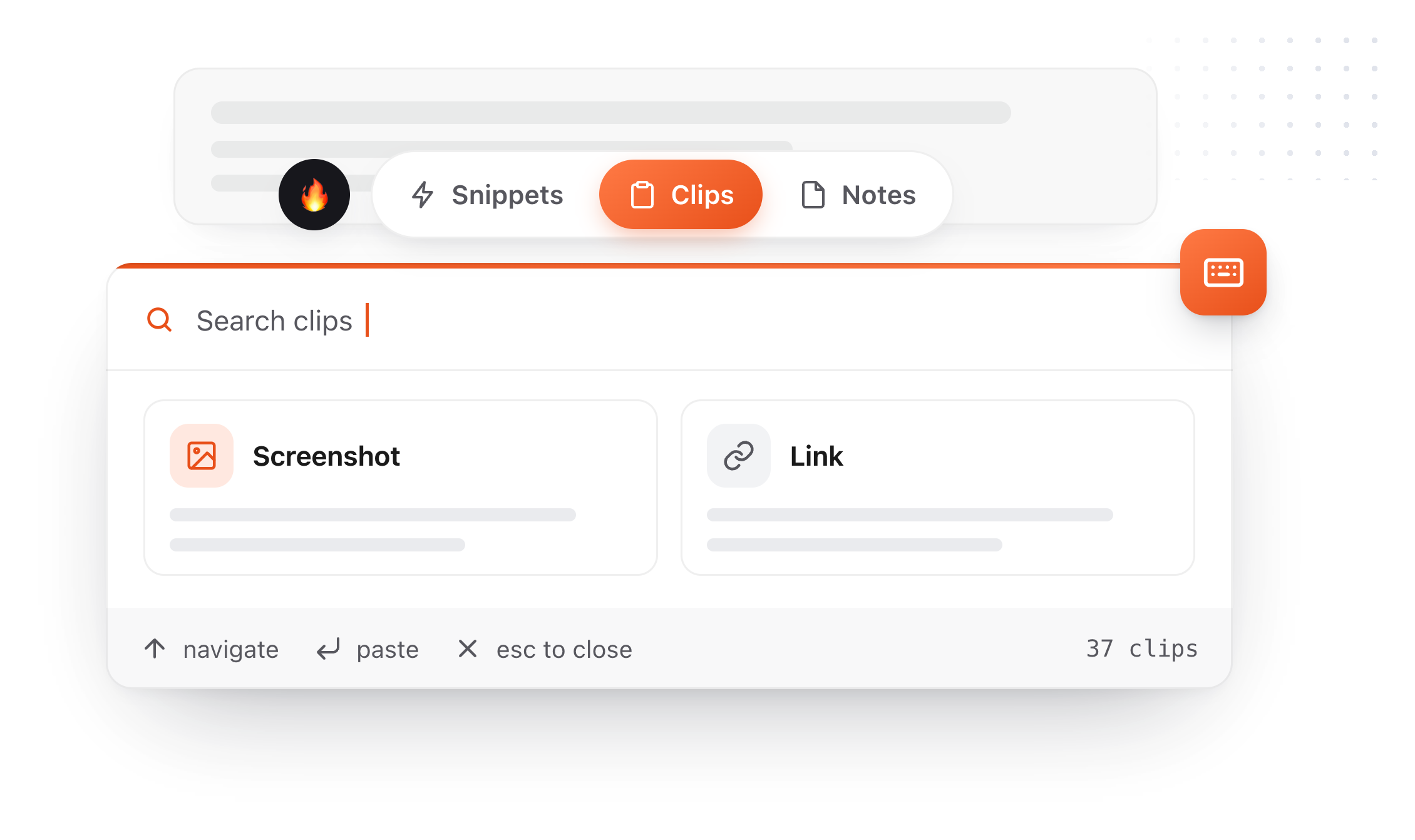
Right-click a clip, choose Save as snippet, give it an abbreviation. The thing you copied once becomes something you type three characters to get, forever. The same conversions run across all three surfaces: a clip becomes a note, and a note you keep rewriting becomes a snippet. Snippets, clips and notes live in one app, which is what makes each of those a single click rather than an export and an import.
- 01
Copy something
It lands in Clips alongside everything else you copied today.
- 02
Save as snippet
It leaves your rolling history and enters your permanent library.
- 03
Give it a trigger
Type
invfrom then on and never look it up again.
A clipboard manager you can tell what to ignore
A clipboard manager sees everything you copy. Until 4.0 the only control over that was a password-manager exclusion you could not see. There are three now, none of them gated, and the limits of the strongest one are stated rather than buried.
Turn image capture off
One switch. Text keeps being captured and pictures stop. Images you have already saved are kept rather than deleted, which is not what most people expect a privacy toggle to do, so it is worth saying.
Name apps to skip
Add any application and TypeFire ignores what you copy in it. Choose from the apps it has already seen, with clip counts, or browse to any app on your Mac. Each app gets one of three settings: allow it, block images only, or block everything you copy there. The middle one is what most people want for a work tool, keeping the text and losing the screenshots.
The password managers, now visible
TypeFire has always ignored password managers. That list is in Settings now, twenty-three apps including 1Password, Bitwarden, KeePassXC, Dashlane and Apple Passwords, blocked by bundle ID in code rather than by a setting you have to find. It shows which of them you have installed, and any one can be overridden.
Encrypted on your Mac
Clips are stored in an encrypted database on your Mac. The key is generated on your machine and kept in the macOS Keychain. Images sit beside it, readable only by your own account.
Secrets expire in minutes
Card numbers and high-entropy strings are detected and deleted after five minutes by default, adjustable in Settings. Everything else follows the retention you choose.
An on-device AI option
Apple Intelligence and local models through Ollama or LM Studio run entirely on your machine. If you pick Claude, OpenAI, or Gemini instead, text goes to that provider directly; TypeFire operates no server in that path.
Where blocking by app stops being a guarantee
macOS does not tell an application which other application wrote to the clipboard. TypeFire matches on the app that was in front at the time, plus any app that identifies itself using the standard convention. That covers the overwhelming majority of real cases and it is not absolute. The protection that does not depend on a guess is the concealed-content marker: password managers mark what they copy, and TypeFire never stores it whatever else is set.
The app list also covers what you copy, not screenshots you save as a file. A PNG on your desktop records nothing about what was on screen, so TypeFire matches those to an app where it can and skips them when it does. It is right in the ordinary case and it is not a promise: to keep saved screenshots out entirely, turn off Save screenshots to Clips.
Eighteen dollars. Once.
TypeFire Pro is a single payment that unlocks unlimited clips, Selection Prompts, Prompt Chains, notes sync, note version history and saving from AI apps through MCP. There is no subscription and no per-seat pricing.
Free tier, then one payment
No free tier at all
One time
No free tier
One time
Lifetime, or $3.99/mo
Five snippets free, then a subscription
A year of Obsidian Sync costs more than TypeFire Pro costs once, and Pro also carries the clipboard manager, Selection Prompts and Prompt Chains.
The graph is free, and it needs nothing
Press ` and TypeFire draws every note, snippet and clip on one canvas, using the links, tags and folders already in your files. Nothing to download and nothing to switch on. A connection you made is drawn solid, one TypeFire worked out is drawn dashed.
Turn on Weave and search starts matching what you meant rather than the exact words you typed. It runs on your Mac, with no account and nothing uploaded.
Moving from Obsidian
Still not answered?
No, and it is not designed to. TypeFire is a layer on the same markdown files.
Obsidian keeps its plugins, its community, its canvas and its mobile apps; TypeFire gives that vault a global hotkey, instant capture and text expansion. Most people run both against one folder rather than choosing.
Yes. Both read and write plain markdown files in a folder you chose, so neither needs to be closed for the other to work.
TypeFire only writes to notes you actually edit, and it does not add a hidden folder to your vault.
No. Saving a note rewrites the part you changed and nothing else, so the file does not come back in a different dialect.
Callouts, embeds, footnotes, raw HTML and your own choice of bullet and emphasis characters survive untouched. A vault of more than ten thousand files opens with not one of them modified.
The core Obsidian app is free and so is TypeFire Notes.
The difference is what sync costs. Obsidian Sync is $4 to $8 a month for as long as you use it, and Obsidian charges $50 per user per year for commercial use.
TypeFire Pro is $18 once, covers three Macs, has no commercial license requirement, and includes notes sync, version history, the clipboard manager, Selection Prompts and Prompt Chains.
No, deliberately. Reviews consistently describe Obsidian's graph as impressive in a demo and unused in practice, while the backlinks panel is the half people rely on.
TypeFire built wikilinks, backlinks and link retargeting on rename, and skipped the graph.
They keep working in Obsidian. TypeFire does not read or run them, and files created by plugins are treated like any other markdown: listed, searchable, and left alone unless you edit them.
Plugin frontmatter is preserved exactly as written.
Mac to Mac today, through your own iCloud, with an iOS app coming soon.
If you write notes on a phone right now, Obsidian Sync covers iOS and Android.
Other comparisons
8 apps, where the notes live
Craft alternativePlain Markdown instead
Bear alternativeFiles, not a database
Obsidian MCPNo plugin, no API key
TypeFire NotesThe whole feature
Quick capture into ObsidianNo plugin needed
Obsidian Sync alternative$18 once, not $4 a month
Obsidian's commercial license$50 per user per year
Loved by people who type all day.
Unprompted reactions from users, in their own words.
Used by people at
Company names are places where our users work. They do not imply endorsement or affiliation.