Joplin alternative for Mac. Markdown in a folder, not in a database.
Is there a Joplin alternative that stores plain files?
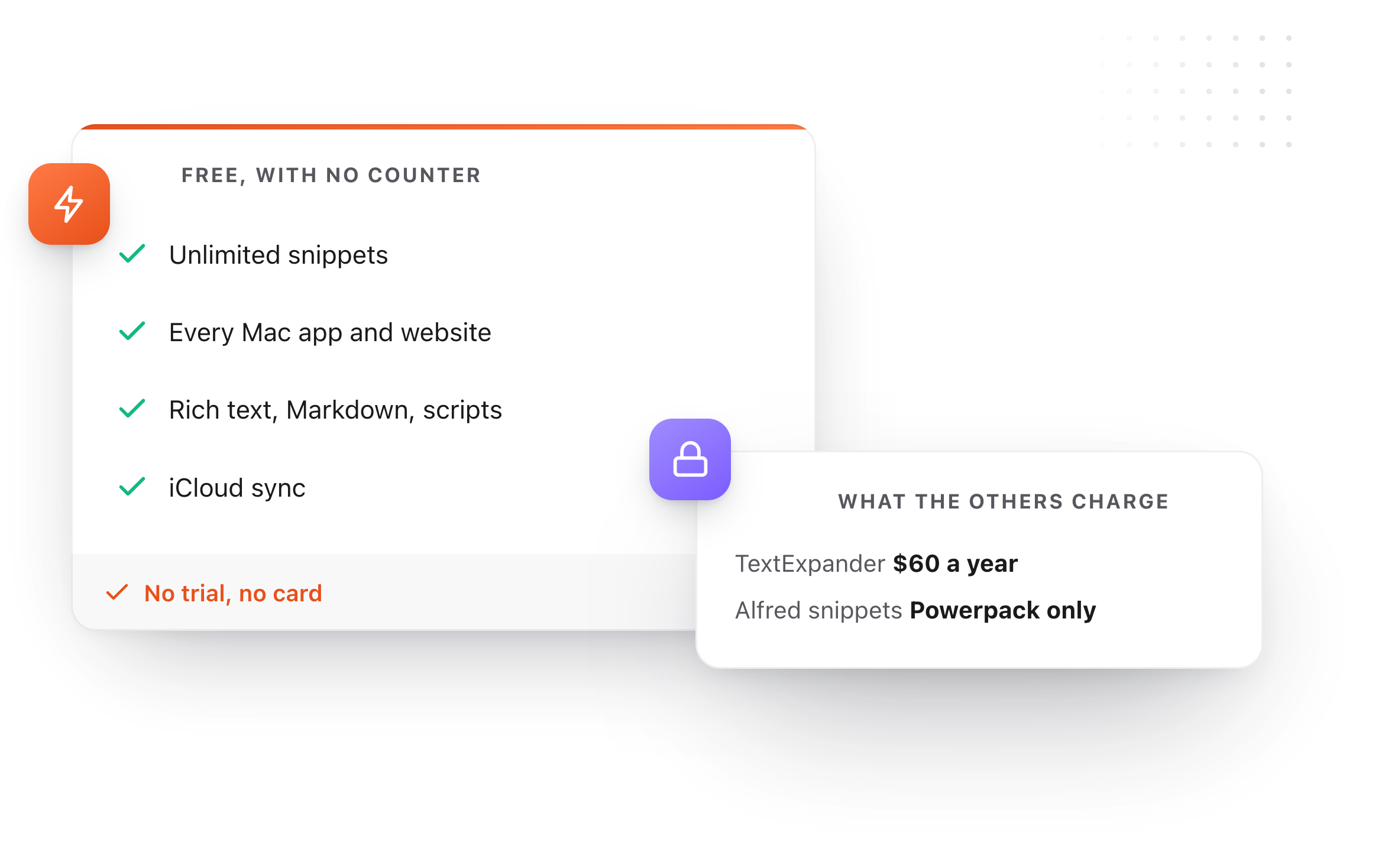
Joplin keeps notes in a local database and syncs through its own layer. TypeFire keeps each note as a plain markdown file in a folder you choose, readable by any editor.
It opens an existing vault in place with no import, syncs over your own iCloud, and is free in full for notes.
Why people move from Joplin
The specific reasons people give for switching.
The file is the note
Joplin stores notes in a local database and synchronizes through a target such as Dropbox or WebDAV. In TypeFire the markdown file in your folder is the note, so Finder, Spotlight, grep and every editor can reach it directly.
It opens a vault you already have
Point it at an existing Obsidian vault or any folder of markdown and it reads it in place, with no import and no second copy.
Reach a note from any app
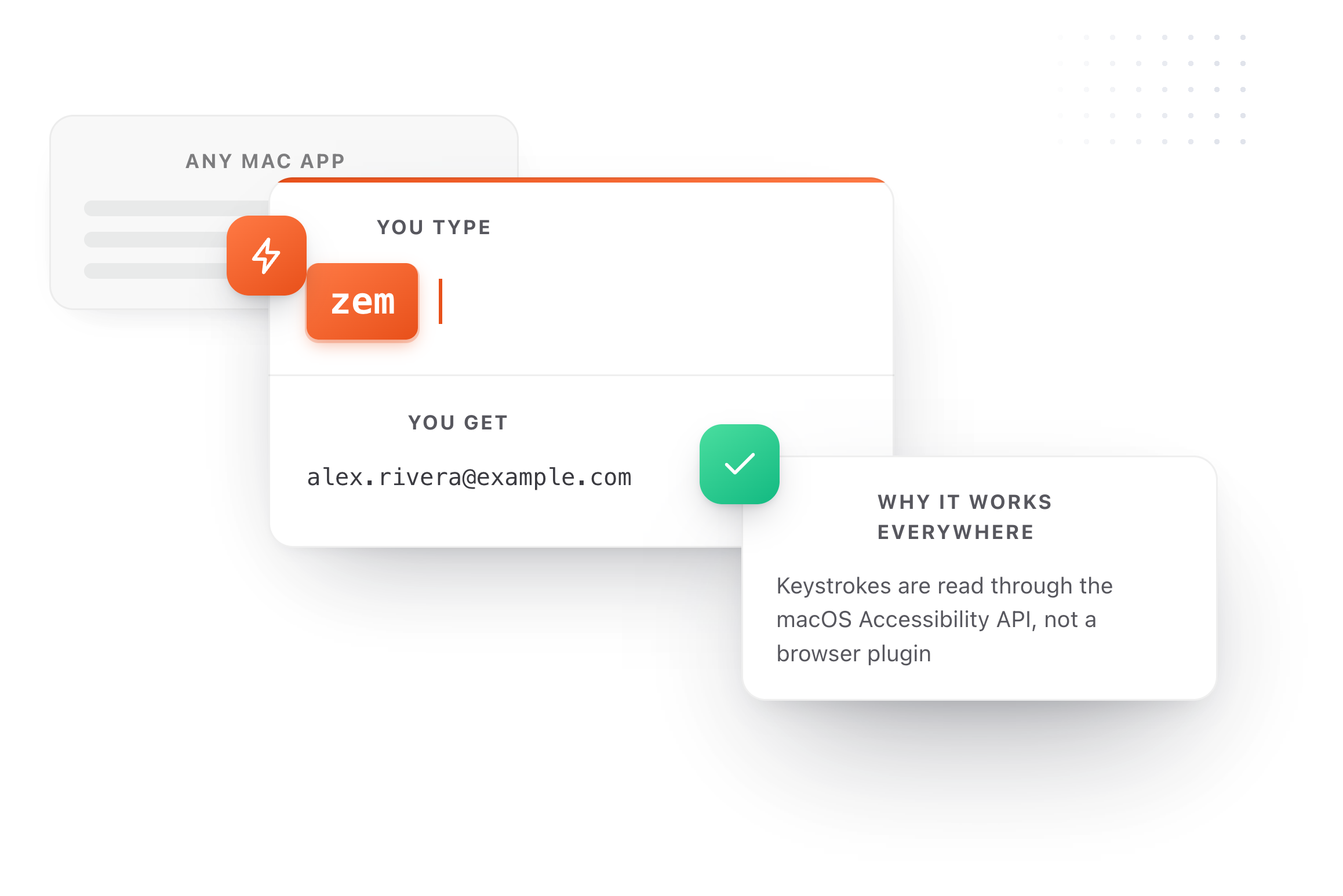
⌘⌃3 searches everything from on top of the app you are in, and Enter pastes into the document you were already writing.
Capture in one keystroke
A note into the vault without opening the app at all.
A text expander and clipboard manager
Both in the same app, both working system-wide, including inside a note.
Native, and fast at scale
A 10,000 note vault lists in 214 milliseconds on a release build.
TypeFire compared with Joplin
Prices and capabilities as of September 2026.
| TypeFire | Joplin | |
|---|---|---|
| Storage | Plain .md files in your folder | Local database |
| Open source | No | Yes |
| End-to-end encrypted sync | No, your own iCloud | Yes |
| Sync targets | iCloud, Mac to Mac | Dropbox, WebDAV, S3, self-hosted |
| Web clipper | No | Yes |
| Global hotkey over other apps | Yes | No |
| Text expander built in | Yes | No |
| Price | Free, Pro $18 once | Free |
What Joplin does better
Four of them, named plainly, with what TypeFire does instead directly below.
Open source and end-to-end encrypted
Joplin is auditable and encrypts your notes before they reach any sync target. TypeFire is closed source and syncs through your own iCloud without adding its own encryption layer. If that is your requirement, Joplin is the correct answer.
Sync anywhere, including self-hosted
Dropbox, OneDrive, Nextcloud, WebDAV, S3 or your own Joplin Server. TypeFire syncs Mac to Mac through iCloud only.
It runs on everything
Windows, Mac, Linux, iOS, Android and a terminal client. TypeFire is a Mac app.
The web clipper
Joplin's clipper saves pages properly. TypeFire has no equivalent.
What TypeFire adds
Not available in Joplin at any price.
Files, directly
No database between you and your markdown.
A global hotkey
Your notes on top of every app, pasted where you are typing.
A clipboard manager with OCR
Searchable by the words inside screenshots.
AI on a note, free
On device with Apple Intelligence, or bring your own key.
Turn anything you copy into something you type
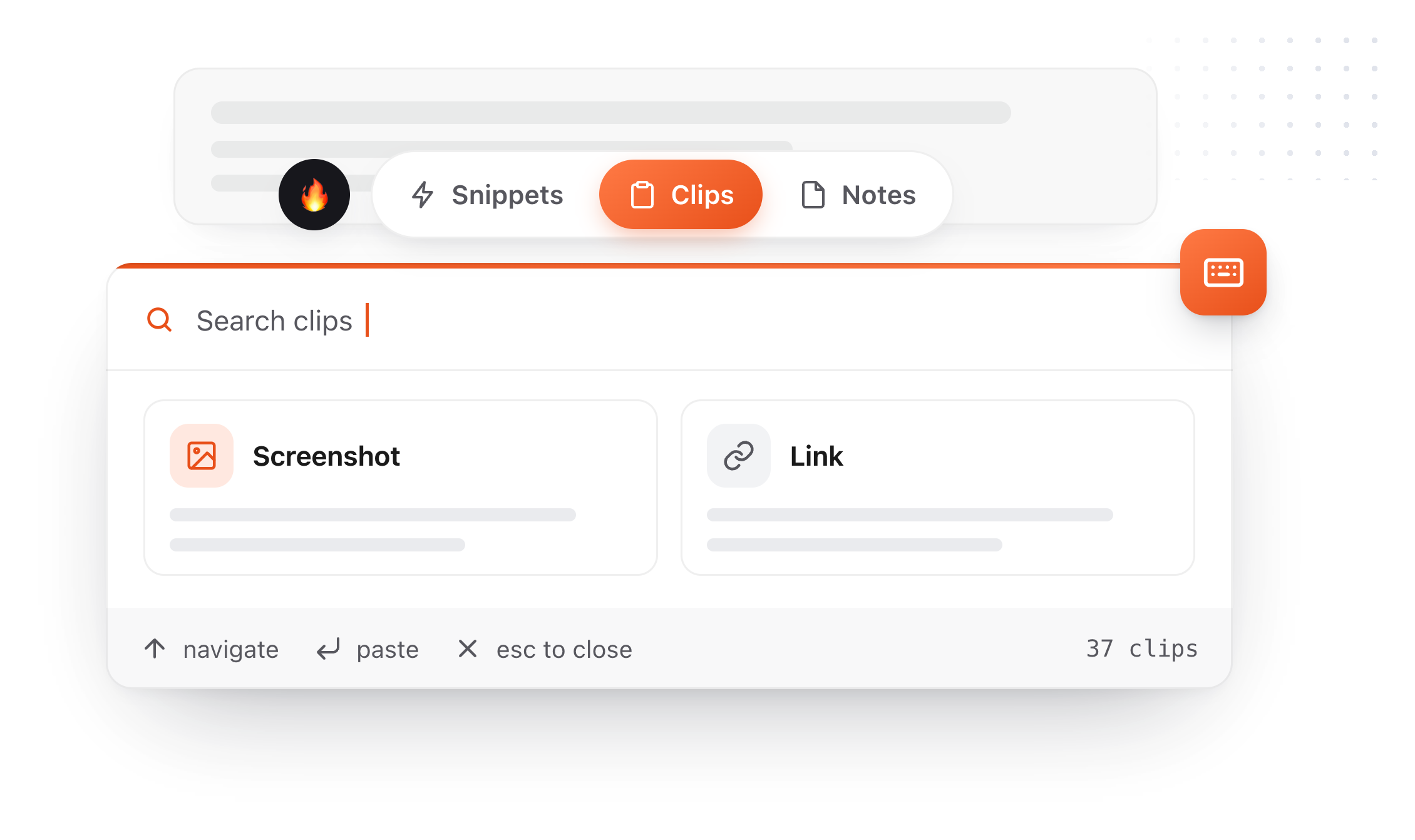
Right-click a clip, choose Save as snippet, give it an abbreviation. The thing you copied once becomes something you type three characters to get, forever. The same conversions run across all three surfaces: a clip becomes a note, and a note you keep rewriting becomes a snippet. Snippets, clips and notes live in one app, which is what makes each of those a single click rather than an export and an import.
- 01
Copy something
It lands in Clips alongside everything else you copied today.
- 02
Save as snippet
It leaves your rolling history and enters your permanent library.
- 03
Give it a trigger
Type
invfrom then on and never look it up again.
A clipboard manager you can tell what to ignore
A clipboard manager sees everything you copy. Until 4.0 the only control over that was a password-manager exclusion you could not see. There are three now, none of them gated, and the limits of the strongest one are stated rather than buried.
Turn image capture off
One switch. Text keeps being captured and pictures stop. Images you have already saved are kept rather than deleted, which is not what most people expect a privacy toggle to do, so it is worth saying.
Name apps to skip
Add any application and TypeFire ignores what you copy in it. Choose from the apps it has already seen, with clip counts, or browse to any app on your Mac. Each app gets one of three settings: allow it, block images only, or block everything you copy there. The middle one is what most people want for a work tool, keeping the text and losing the screenshots.
The password managers, now visible
TypeFire has always ignored password managers. That list is in Settings now, twenty-three apps including 1Password, Bitwarden, KeePassXC, Dashlane and Apple Passwords, blocked by bundle ID in code rather than by a setting you have to find. It shows which of them you have installed, and any one can be overridden.
Encrypted on your Mac
Clips are stored in an encrypted database on your Mac. The key is generated on your machine and kept in the macOS Keychain. Images sit beside it, readable only by your own account.
Secrets expire in minutes
Card numbers and high-entropy strings are detected and deleted after five minutes by default, adjustable in Settings. Everything else follows the retention you choose.
An on-device AI option
Apple Intelligence and local models through Ollama or LM Studio run entirely on your machine. If you pick Claude, OpenAI, or Gemini instead, text goes to that provider directly; TypeFire operates no server in that path.
Where blocking by app stops being a guarantee
macOS does not tell an application which other application wrote to the clipboard. TypeFire matches on the app that was in front at the time, plus any app that identifies itself using the standard convention. That covers the overwhelming majority of real cases and it is not absolute. The protection that does not depend on a guess is the concealed-content marker: password managers mark what they copy, and TypeFire never stores it whatever else is set.
The app list also covers what you copy, not screenshots you save as a file. A PNG on your desktop records nothing about what was on screen, so TypeFire matches those to an app where it can and skips them when it does. It is right in the ordinary case and it is not a promise: to keep saved screenshots out entirely, turn off Save screenshots to Clips.
Eighteen dollars. Once.
TypeFire Pro is a single payment that unlocks unlimited clips, Selection Prompts, Prompt Chains, notes sync, note version history and saving from AI apps through MCP. There is no subscription and no per-seat pricing.
Free tier, then one payment
No free tier at all
One time
No free tier
One time
Lifetime, or $3.99/mo
Five snippets free, then a subscription
Two months of Paste, or all of TypeFire.
The graph is free, and it needs nothing
Press ` and TypeFire draws every note, snippet and clip on one canvas, using the links, tags and folders already in your files. Nothing to download and nothing to switch on. A connection you made is drawn solid, one TypeFire worked out is drawn dashed.
Turn on Weave and search starts matching what you meant rather than the exact words you typed. It runs on your Mac, with no account and nothing uploaded.
Moving from Joplin
Still not answered?
Obsidian and TypeFire are the closest for local markdown.
TypeFire suits you if you want notes as plain files in a folder rather than in a database, and want to reach them by a global hotkey from inside any other app. Joplin remains the better answer if open source and end-to-end encrypted sync are requirements.
Joplin writes markdown but keeps it inside its own local database and syncs that to a target you choose, so the notes are not loose .md files you can open directly in Finder.
TypeFire's notes are ordinary files in a folder, which is why other tools can read them without an export.
Yes. Joplin exports to Markdown, producing a folder of .md files with attachments.
Point TypeFire at that folder and it opens them in place. Joplin's note IDs and internal links will need checking, since TypeFire uses wikilinks and standard markdown links.
The clipboard database is encrypted on your Mac.
Notes are plain markdown files by design, because the point is that any tool can read them, and sync runs through your own iCloud rather than our servers. If you need end-to-end encrypted note sync, Joplin does that and TypeFire does not.
Other comparisons
8 apps, where the notes live
Apple Notes alternativeNotes that are files
Notion alternativeLocal files, no workspace
TypeFire NotesThe whole feature
Logseq alternativeFiles without the outline
Markdown notes for MacPlain files you own
Evernote alternativeGet your notes back as files
Loved by people who type all day.
Unprompted reactions from users, in their own words.
Used by people at
Company names are places where our users work. They do not imply endorsement or affiliation.