QLMarkdown alternative for Mac. The same Space key, and an editor behind it.
Is there an alternative to QLMarkdown that also edits the file?
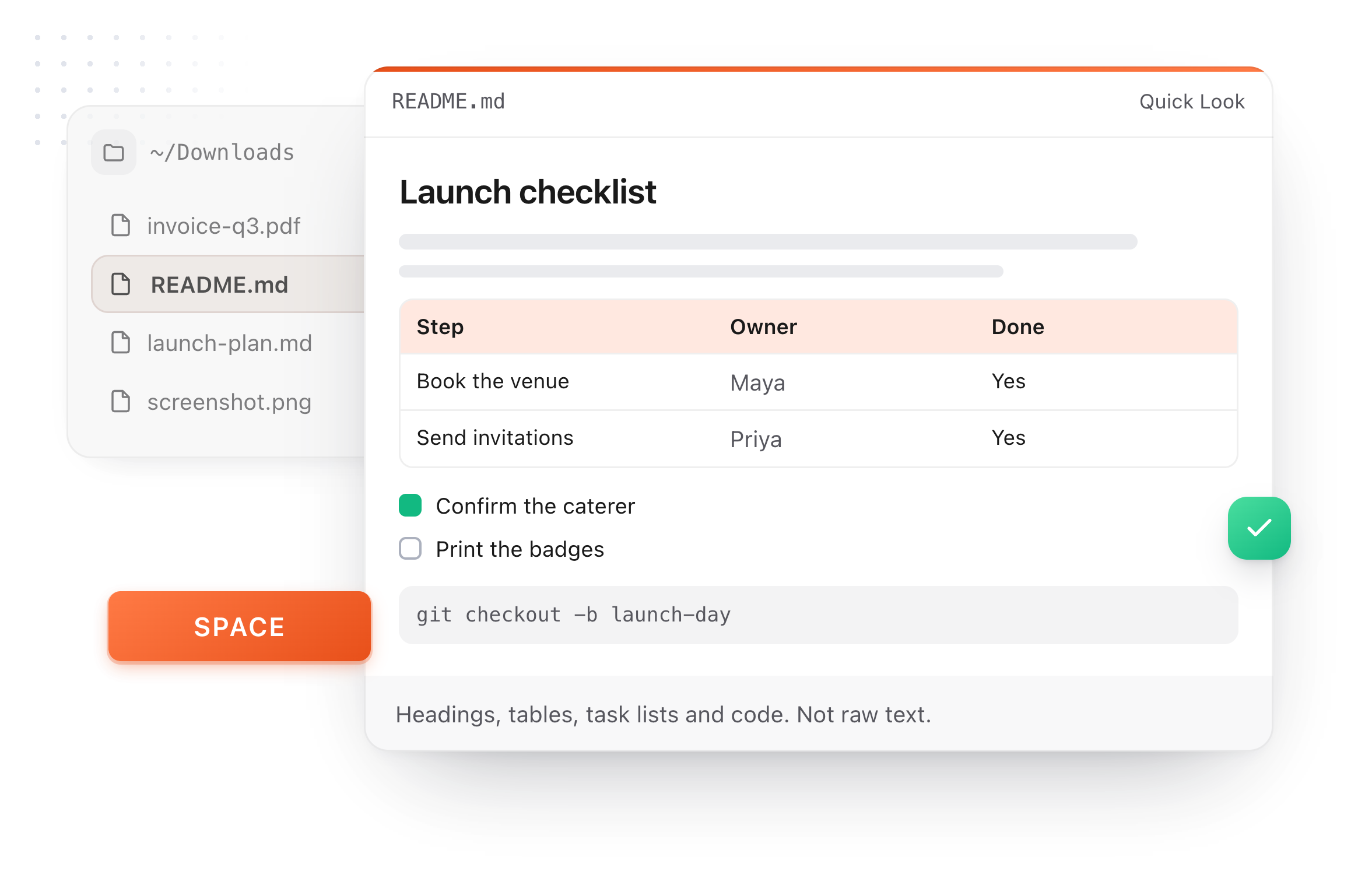
Yes. TypeFire ships the same Quick Look preview for Markdown, free, and opens the file in a live preview editor on double click. QLMarkdown is preview only.
QLMarkdown renders Mermaid and math, which TypeFire does not. TypeFire adds an editor, a notes app that adopts the folder, a clipboard manager and a text expander, from one install with nothing to enable.
What changes when the preview comes with an app
QLMarkdown stops at the preview. These are the things people wanted next.
Double click opens the file, rendered, editable
With QLMarkdown, Space shows the document and double click sends it to whatever claimed .md last, often TextEdit or Xcode. With TypeFire the same file opens in a Markdown editor that renders as you type and saves the file byte for byte.
The folder can become a vault
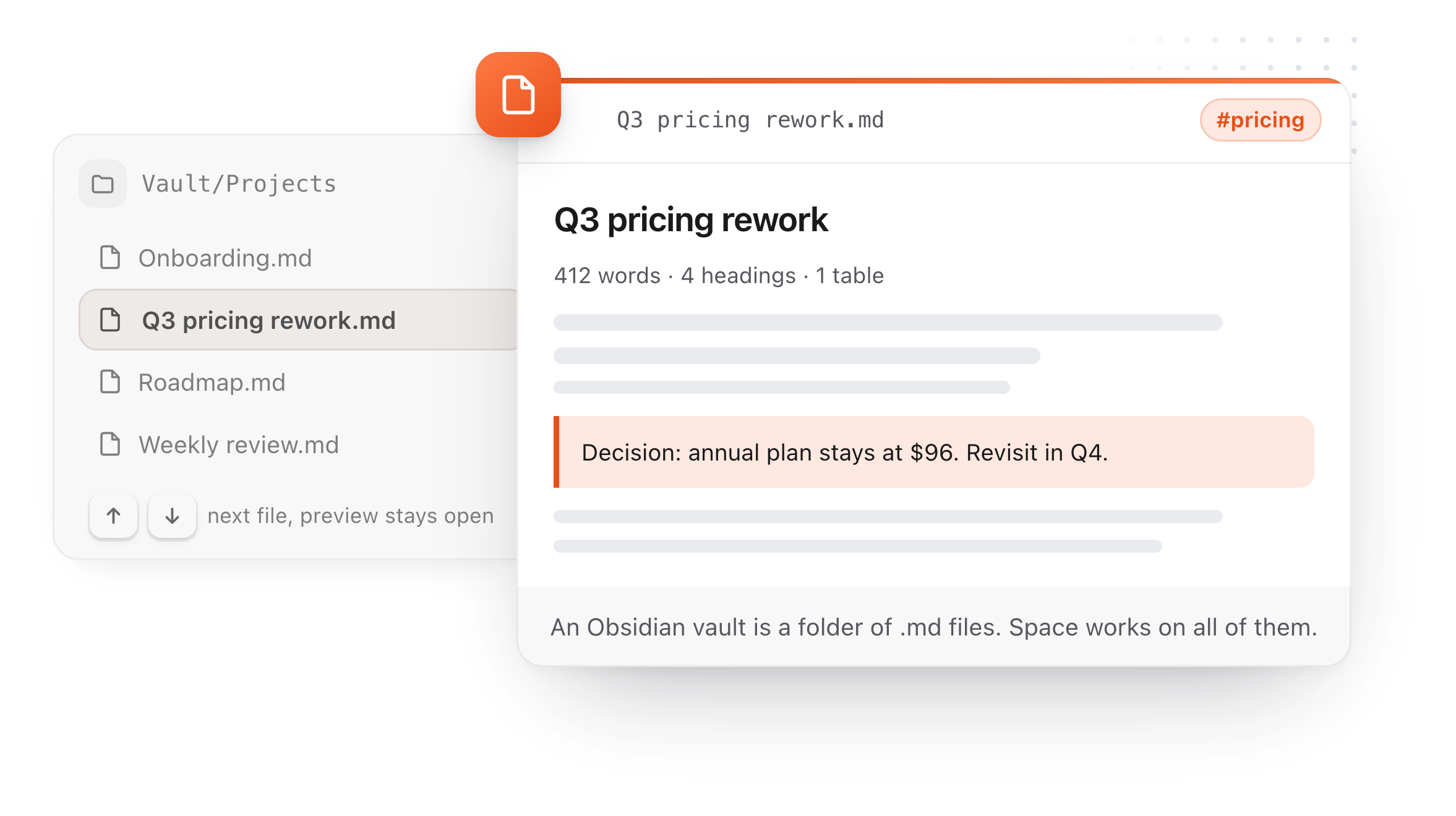
A README is one file. A folder of notes is a library. TypeFire opens that folder in place, with wikilinks, backlinks, tags, daily notes and a graph, and nothing is imported or copied.
Nothing to install separately, nothing to launch once
QLMarkdown needs Homebrew or a GitHub download, then one launch so macOS discovers the extension. TypeFire registers its extension when the app is installed. There is no first run step and no setting.
A preview that runs no script and fetches nothing
Markdown can carry HTML, and HTML can carry a script or a remote image. TypeFire's preview runs none of it and makes no network request, so a file from a stranger renders as a document and does nothing else.
A clipboard manager and a text expander in the same install
The things a developer who cares about Quick Look tends to install next are a clipboard history and snippets. Both are in the same app, with one Accessibility permission.
Removing it removes everything
The extension lives inside TypeFire.app. Drag the app to the Trash and the extension goes with it, with nothing left in Library.
TypeFire compared with QLMarkdown
Prices and capabilities as of September 2026.
| TypeFire | QLMarkdown | |
|---|---|---|
| Price | Free | Free, open source, GPL |
| Install | Comes with the app | Homebrew cask or GitHub release, launch once |
| Signed and notarized | Yes | Yes |
| Headings, lists, tables, code, task lists | Yes | Yes |
| Pictures inline | Yes | Yes |
| Mermaid diagrams | No | Yes |
| Math | No | Yes, MathJax |
| Syntax highlighting in code blocks | Monospaced block | Yes, many languages |
| R Markdown, MDX, Quarto | No | Yes |
| Opens and edits the file | Yes, live preview editor | No, preview only |
| Notes, clipboard, text expander | Yes | No |
| macOS floor | 13 | Recent macOS, see the project page |
QLMarkdown is at github.com/sbarex/QLMarkdown. Both extensions render the everyday Markdown the same way; the rows where QLMarkdown wins are the specialist ones.
What QLMarkdown does better
Three of them, named plainly, with what TypeFire does instead directly below.
Mermaid diagrams and math
QLMarkdown renders Mermaid flowcharts and MathJax equations inside the preview. TypeFire does not. If your notes carry either, that is a real difference, and TypeFire opens the same file in its editor where the source is at least readable.
Syntax highlighting, and unusual flavors
Code blocks are colored per language, and R Markdown, MDX and Quarto files preview too. TypeFire shows code in a monospaced block and handles .md and .markdown.
It is open source
You can read exactly what it does with a file. TypeFire is not open source. What it offers instead is the behavior itself: the preview runs no script, makes no network request, and reads only the file and the pictures beside it.
What TypeFire adds
Not available in QLMarkdown at any price.
An editor on double click
The same file, rendered as you type, saved byte for byte.
The folder as a vault
Wikilinks, backlinks, tags and a graph over the files you already have.
Clipboard history and snippets
The two installs that usually come next, already in.
One install, no first launch
The extension is registered the moment the app is.
Turn anything you copy into something you type
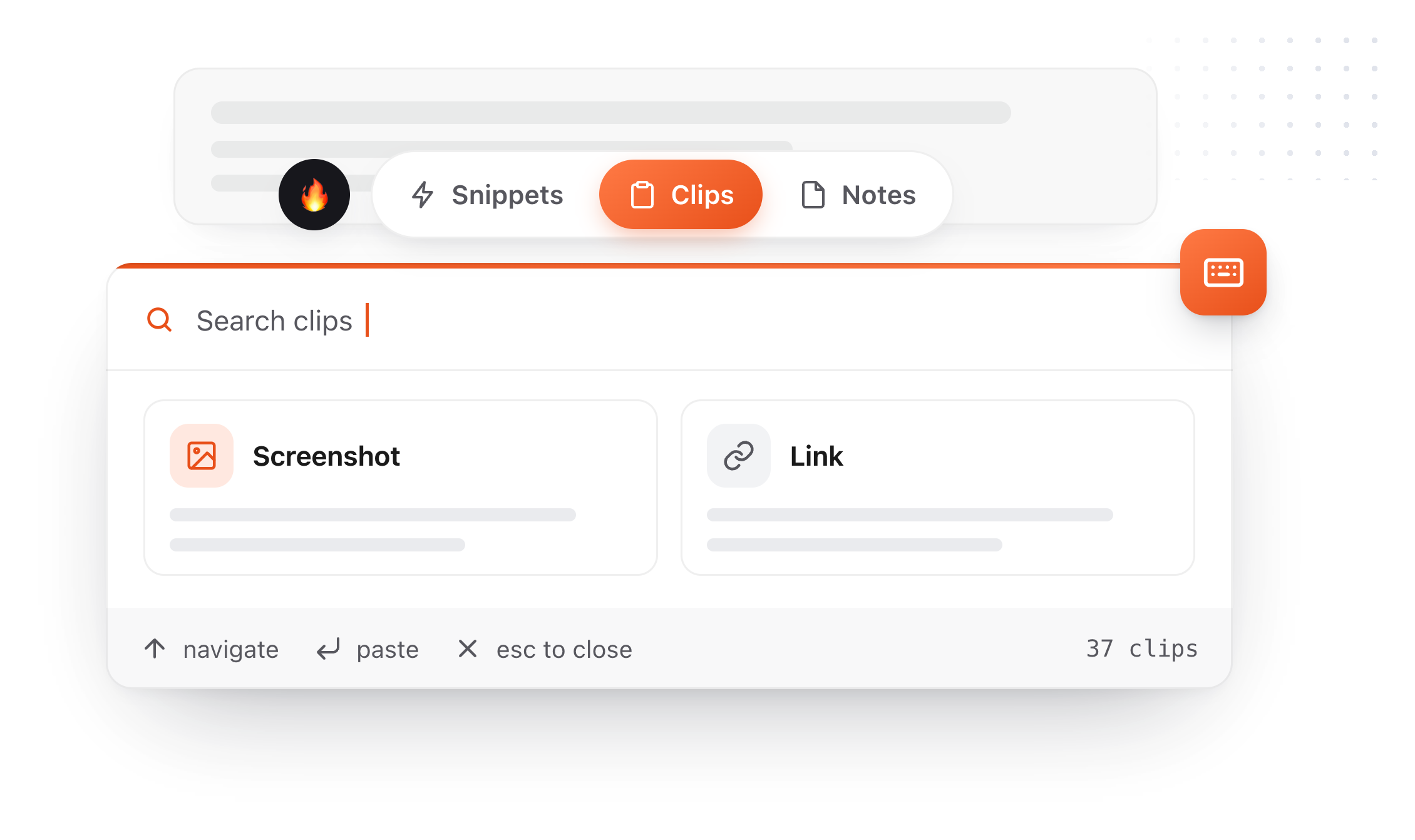
Right-click a clip, choose Save as snippet, give it an abbreviation. The thing you copied once becomes something you type three characters to get, forever. The same conversions run across all three surfaces: a clip becomes a note, and a note you keep rewriting becomes a snippet. Snippets, clips and notes live in one app, which is what makes each of those a single click rather than an export and an import.
- 01
Copy something
It lands in Clips alongside everything else you copied today.
- 02
Save as snippet
It leaves your rolling history and enters your permanent library.
- 03
Give it a trigger
Type
invfrom then on and never look it up again.
A clipboard manager you can tell what to ignore
A clipboard manager sees everything you copy. Until 4.0 the only control over that was a password-manager exclusion you could not see. There are three now, none of them gated, and the limits of the strongest one are stated rather than buried.
Turn image capture off
One switch. Text keeps being captured and pictures stop. Images you have already saved are kept rather than deleted, which is not what most people expect a privacy toggle to do, so it is worth saying.
Name apps to skip
Add any application and TypeFire ignores what you copy in it. Choose from the apps it has already seen, with clip counts, or browse to any app on your Mac. Each app gets one of three settings: allow it, block images only, or block everything you copy there. The middle one is what most people want for a work tool, keeping the text and losing the screenshots.
The password managers, now visible
TypeFire has always ignored password managers. That list is in Settings now, twenty-three apps including 1Password, Bitwarden, KeePassXC, Dashlane and Apple Passwords, blocked by bundle ID in code rather than by a setting you have to find. It shows which of them you have installed, and any one can be overridden.
Encrypted on your Mac
Clips are stored in an encrypted database on your Mac. The key is generated on your machine and kept in the macOS Keychain. Images sit beside it, readable only by your own account.
Secrets expire in minutes
Card numbers and high-entropy strings are detected and deleted after five minutes by default, adjustable in Settings. Everything else follows the retention you choose.
An on-device AI option
Apple Intelligence and local models through Ollama or LM Studio run entirely on your machine. If you pick Claude, OpenAI, or Gemini instead, text goes to that provider directly; TypeFire operates no server in that path.
Where blocking by app stops being a guarantee
macOS does not tell an application which other application wrote to the clipboard. TypeFire matches on the app that was in front at the time, plus any app that identifies itself using the standard convention. That covers the overwhelming majority of real cases and it is not absolute. The protection that does not depend on a guess is the concealed-content marker: password managers mark what they copy, and TypeFire never stores it whatever else is set.
The app list also covers what you copy, not screenshots you save as a file. A PNG on your desktop records nothing about what was on screen, so TypeFire matches those to an app where it can and skips them when it does. It is right in the ordinary case and it is not a promise: to keep saved screenshots out entirely, turn off Save screenshots to Clips.
Eighteen dollars. Once.
TypeFire Pro is a single payment that unlocks unlimited clips, Selection Prompts, Prompt Chains, notes sync, note version history and saving from AI apps through MCP. There is no subscription and no per-seat pricing.
Free tier, then one payment
No free tier at all
One time
No free tier
One time
Lifetime, or $3.99/mo
Five snippets free, then a subscription
Quick Look, the editor, notes, the clipboard and snippets are all free. Pro is $18 once, and Quick Look is not in it.
The graph is free, and it needs nothing
Press ` and TypeFire draws every note, snippet and clip on one canvas, using the links, tags and folders already in your files. Nothing to download and nothing to switch on. A connection you made is drawn solid, one TypeFire worked out is drawn dashed.
Turn on Weave and search starts matching what you meant rather than the exact words you typed. It runs on your Mac, with no account and nothing uploaded.
Moving from QLMarkdown
Still not answered?
Yes, as of September 2026 the repository is active, with a signed and notarized build available through Homebrew and GitHub releases.
It is a solo project, which the maintainer says openly, and it has been reliable for years.
You can, but macOS chooses one Quick Look extension for .md files and the choice is not predictable.
If you want TypeFire's preview, remove QLMarkdown. If you want Mermaid and math in previews, keep QLMarkdown and use TypeFire for editing, notes, clipboard and snippets, which do not touch Quick Look.
No. It renders headings, lists, tables, task lists, code blocks, blockquotes, links and pictures.
QLMarkdown, Imark and Anybox's Markdown Preview render Mermaid and math if your files need them.
Yes, and it is not part of Pro. It arrives with the app, registers itself on install, and works on every .md file on the Mac on macOS 13 and later, Intel or Apple silicon.
TypeFire's preview runs no script, makes no network request, and reads only the file and the pictures beside it, so a file from a stranger renders as a document and does nothing else.
QLMarkdown is open source, so you can read what it does; check its settings for how it treats raw HTML.
Other comparisons
The feature, in full
Best Quick Look plugins for MacMarkdown, code, video
MacMD Viewer alternative$19.99 against free
Quick Look shows raw text?The fixes, in order
Markdown editor for MacWhat double click opens
Typora alternativePreview in Finder too
TypeFire NotesAdopt the folder
Loved by people who type all day.
Unprompted reactions from users, in their own words.
Used by people at
Company names are places where our users work. They do not imply endorsement or affiliation.