A Flycut alternative
that keeps more than text
Is there a Flycut alternative that keeps images?
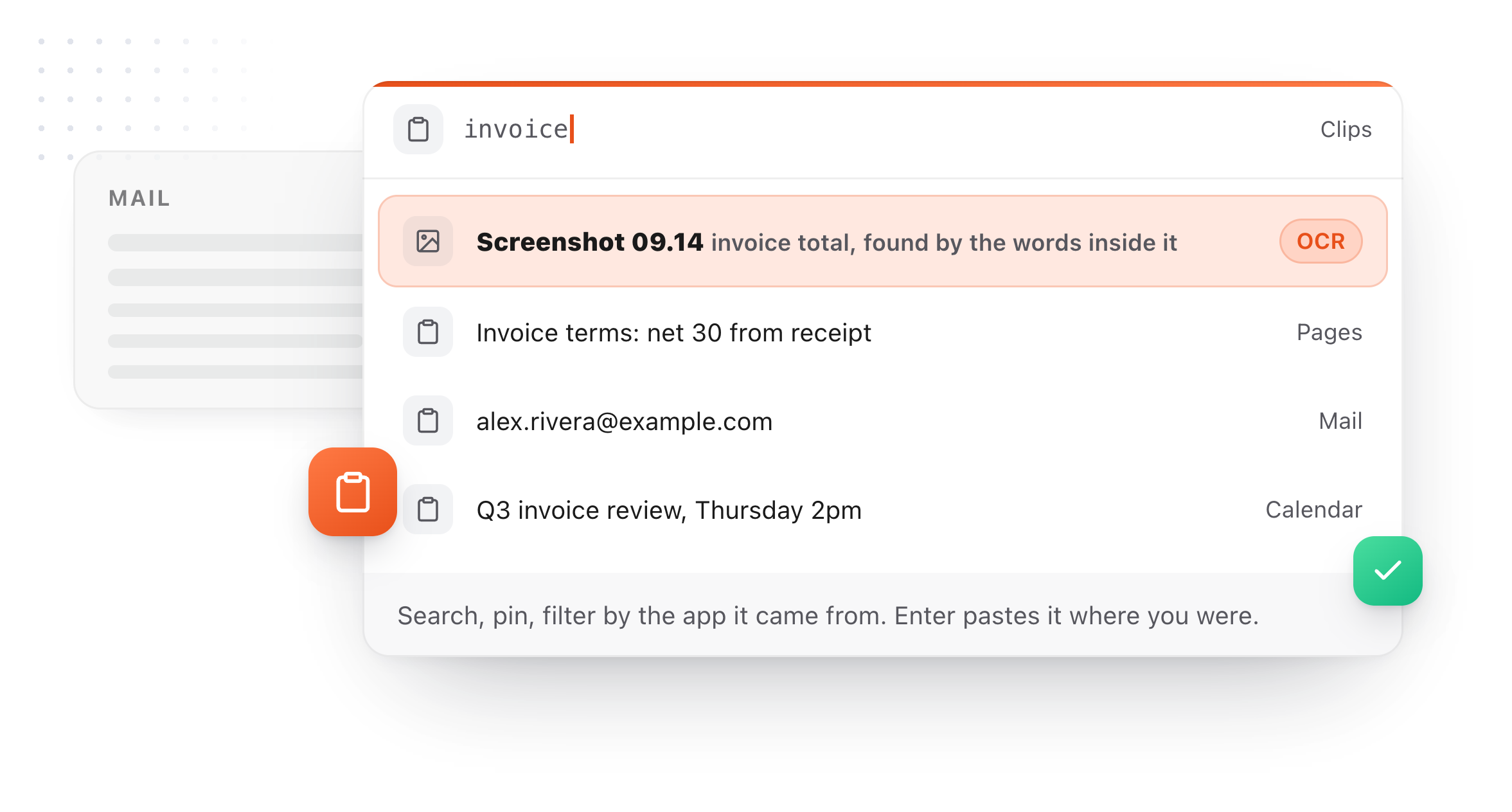
Flycut keeps plain text only. TypeFire keeps text, images, files, links and colors, and reads the words inside every screenshot on device so images are searchable.
The free tier covers your 10 most recent clips with every feature on. Pro is $18 once for up to three Macs.
Why people move from Flycut
The specific reasons people give for switching.
Text only, by design
Flycut is a Jumpcut fork built for code snippets and terminal output. Copy a screenshot, a file or a color and it is not there. TypeFire keeps all of them, with a preview that suits each type.
No OCR, because there are no images
The single most useful thing a developer copies all day is a screenshot of an error. TypeFire reads the text inside every image at capture, so you can find that screenshot by the error message in it.
No text expansion
Flycut is a clipboard buffer. Boilerplate, license headers, import blocks and commit prefixes are a different problem, and one a text expander solves better than a clipboard history does.
No scripting on clips
TypeFire snippets can run JavaScript or AppleScript and paste whatever they return, and prompt chains can transform a selection in several steps. Flycut pastes what you copied.
Organization is minimal
Flycut is deliberately a flat buffer. TypeFire adds pinning, tags, renaming, source-app filters and retention rules you control by age, count or disk budget.

TypeFire compared with Flycut
Prices and capabilities as of September 2026.
| TypeFire | Flycut | |
|---|---|---|
| Price | $0, then $18 once for unlimited | Free, open source |
| Clip limit on free | 10 most recent | Configurable, unlimited |
| Images and screenshots | Yes, with OCR search | No, text only |
| Files, links, colors | Yes | No |
| Search across clips | Yes, including inside images | Yes, text |
| Text expander | Yes, unlimited, free | No |
| Script snippets | JavaScript and AppleScript | No |
| AI actions on clips | Yes, free tier | No |
| Open source | No | Yes |
| Apple silicon and Intel | Yes, one download | Yes |
Flycut details from its public repository, August 2026. Both apps keep clipboard history on your Mac.
What Flycut does better
Three of them, named plainly, with what TypeFire does instead directly below.
Free, open source and unlimited
Flycut costs nothing, you can read the source, and there is no cap. For a developer who wants a text-only paste buffer and nothing else, it is close to ideal and TypeFire is more app than the job needs.
Deliberately minimal
No settings sprawl, no database, no permissions beyond what it needs. That restraint is a feature, and it is why Flycut has lasted.
It does not watch your images
If you would rather your clipboard manager never touch screenshots at all, text-only is a privacy posture, not a limitation.
What TypeFire adds
Not available in Flycut at any price.
Screenshots you can search
On-device text recognition reads every image you copy, so the screenshot of a stack trace is findable by the exception name in it. Free tier, offline.
A text expander for boilerplate
Abbreviations that expand in every Mac app and every website. Imports, license headers, error handling blocks, commit prefixes, the SQL you never remember exactly.
Snippets that run
A snippet can execute JavaScript or AppleScript and paste what it returns, which turns a clipboard entry into live data rather than stored text.
Everything else you copy
Files, links and colors, with a color arriving as a swatch you can copy back as HEX, RGB, HSL or CMYK.
Encrypted storage
Encrypted on your Mac, and anything a password manager marks confidential is never captured.
Turn anything you copy into something you type
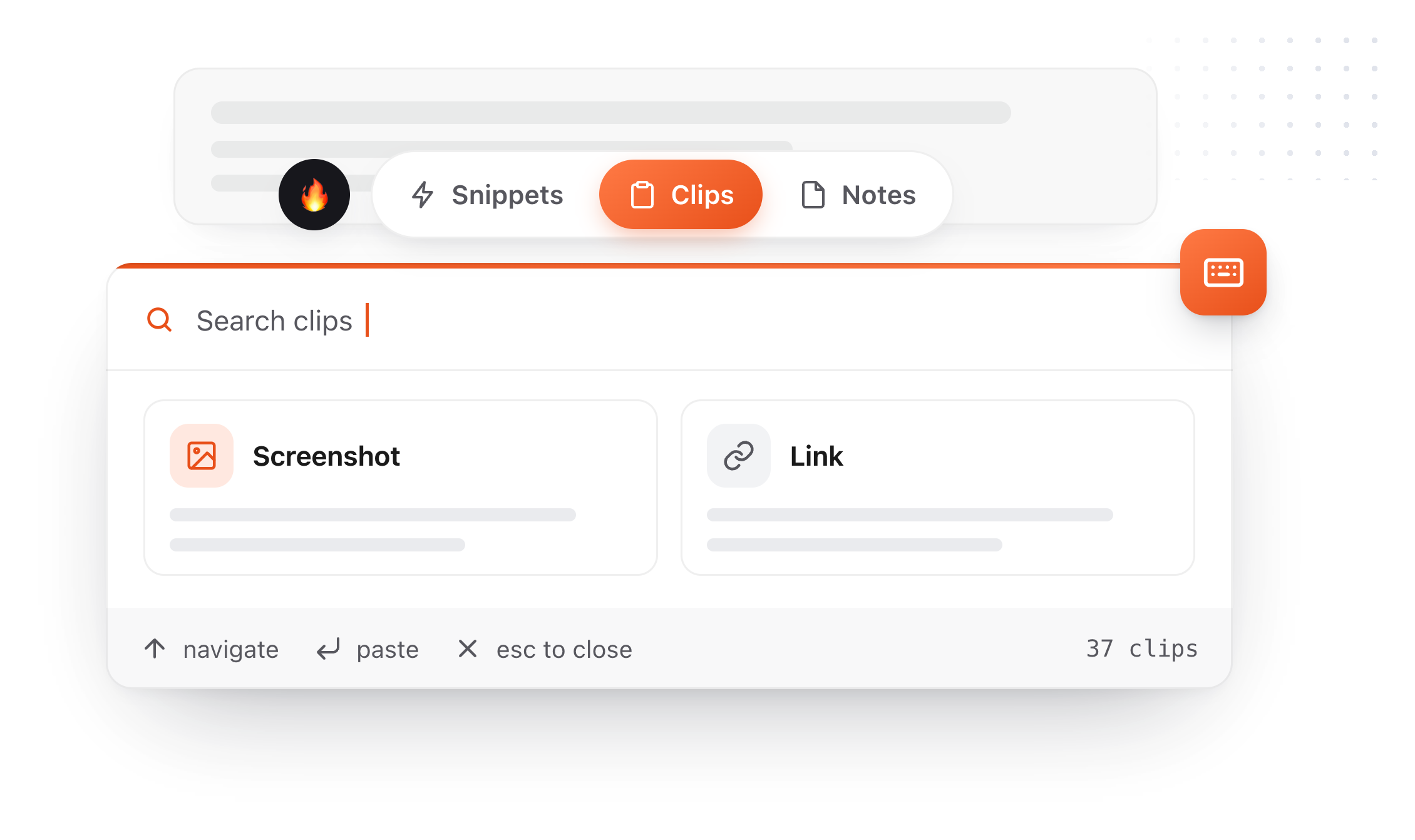
Right-click a clip, choose Save as snippet, give it an abbreviation. The thing you copied once becomes something you type three characters to get, forever. The same conversions run across all three surfaces: a clip becomes a note, and a note you keep rewriting becomes a snippet. Snippets, clips and notes live in one app, which is what makes each of those a single click rather than an export and an import.
- 01
Copy something
It lands in Clips alongside everything else you copied today.
- 02
Save as snippet
It leaves your rolling history and enters your permanent library.
- 03
Give it a trigger
Type
invfrom then on and never look it up again.
A clipboard manager you can tell what to ignore
A clipboard manager sees everything you copy. Until 4.0 the only control over that was a password-manager exclusion you could not see. There are three now, none of them gated, and the limits of the strongest one are stated rather than buried.
Turn image capture off
One switch. Text keeps being captured and pictures stop. Images you have already saved are kept rather than deleted, which is not what most people expect a privacy toggle to do, so it is worth saying.
Name apps to skip
Add any application and TypeFire ignores what you copy in it. Choose from the apps it has already seen, with clip counts, or browse to any app on your Mac. Each app gets one of three settings: allow it, block images only, or block everything you copy there. The middle one is what most people want for a work tool, keeping the text and losing the screenshots.
The password managers, now visible
TypeFire has always ignored password managers. That list is in Settings now, twenty-three apps including 1Password, Bitwarden, KeePassXC, Dashlane and Apple Passwords, blocked by bundle ID in code rather than by a setting you have to find. It shows which of them you have installed, and any one can be overridden.
Encrypted on your Mac
Clips are stored in an encrypted database on your Mac. The key is generated on your machine and kept in the macOS Keychain. Images sit beside it, readable only by your own account.
Secrets expire in minutes
Card numbers and high-entropy strings are detected and deleted after five minutes by default, adjustable in Settings. Everything else follows the retention you choose.
An on-device AI option
Apple Intelligence and local models through Ollama or LM Studio run entirely on your machine. If you pick Claude, OpenAI, or Gemini instead, text goes to that provider directly; TypeFire operates no server in that path.
Where blocking by app stops being a guarantee
macOS does not tell an application which other application wrote to the clipboard. TypeFire matches on the app that was in front at the time, plus any app that identifies itself using the standard convention. That covers the overwhelming majority of real cases and it is not absolute. The protection that does not depend on a guess is the concealed-content marker: password managers mark what they copy, and TypeFire never stores it whatever else is set.
The app list also covers what you copy, not screenshots you save as a file. A PNG on your desktop records nothing about what was on screen, so TypeFire matches those to an app where it can and skips them when it does. It is right in the ordinary case and it is not a promise: to keep saved screenshots out entirely, turn off Save screenshots to Clips.
Eighteen dollars. Once.
TypeFire Pro is a single payment that unlocks unlimited clips, Selection Prompts, Prompt Chains, notes sync, note version history and saving from AI apps through MCP. There is no subscription and no per-seat pricing.
Free tier, then one payment
No free tier at all
One time
No free tier
One time
Lifetime, or $3.99/mo
Five snippets free, then a subscription
Flycut is free and text-only. TypeFire is free at 10 clips with images, OCR and a text expander, and $18 once for unlimited.
The graph is free, and it needs nothing
Press ` and TypeFire draws every note, snippet and clip on one canvas, using the links, tags and folders already in your files. Nothing to download and nothing to switch on. A connection you made is drawn solid, one TypeFire worked out is drawn dashed.
Turn on Weave and search starts matching what you meant rather than the exact words you typed. It runs on your Mac, with no account and nothing uploaded.
Moving from Flycut
Still not answered?
Flycut is a small menu bar buffer that does one thing, and TypeFire is a native Mac app with no bundled browser runtime that does three: a clipboard history you can search by the words inside a screenshot, a text expander, and notes.
It stays out of the way in the menu bar and idles at a few tens of megabytes, which is the footprint of the extra work, not of a web page in a window.
That is a large part of who uses it. Script snippets run JavaScript or AppleScript and paste what they return, dynamic tokens insert dates and clipboard contents, per-snippet hotkeys skip abbreviations entirely, and expansion works in VS Code, Cursor, Zed, the JetBrains IDEs, Sublime, Vim and Neovim in a normal terminal.
The clipboard half keeps code, terminal output and screenshots of errors, all searchable.
For images and OCR search, for the text expander, and for the clip-to-snippet loop.
If your clipboard needs are text-only and your boilerplate lives in editor snippets already, Flycut costs nothing and does the job. TypeFire is worth $18 when you want one app covering both halves.
You can, but two apps watching the same pasteboard is rarely a good idea: you get duplicate entries and occasional races over who restores the clipboard after a paste.
Pick one. If you are trialling TypeFire, quit Flycut for the week rather than running them side by side.
Loved by people who type all day.
Unprompted reactions from users, in their own words.
Used by people at
Company names are places where our users work. They do not imply endorsement or affiliation.