Turn Anything You Copied Into a Reusable Snippet
There is a specific moment worth noticing. You open clipboard history, scroll past a few things, and find the paragraph you were looking for. Then you realize you did the same thing last week.
That paragraph has stopped being a clip. Nothing in your setup told you, and nothing offered to do anything about it.
Why this happens
Clipboard history is recency-based. It answers "what did I copy recently", and it is excellent at that. Everything ages out eventually, because that is the design.
But some of what passes through your clipboard is not recent, it is recurring. The support reply you send twice a week. The address. The license header. The API snippet you never remember exactly.
Recurring things in a recency system means you go looking for them, every time, forever. The cost is small each time and large across a year.
The signal
Anything you have deliberately fetched from clipboard history more than once should not be in clipboard history.
That is the whole rule. Not "old" things, not "important" things. Things you went back for. Going back a second time is the app telling you this belongs somewhere permanent.
Where it should go instead
Into a snippet with an abbreviation. You give the block of text a short trigger like zsup, and from then on typing those four characters produces the paragraph, in any app, with no searching at all.
The difference in daily use is not subtle:
- Clip: shortcut, search or scroll, find it, select, paste, get back to what you were doing
- Snippet: type four characters
The problem with two apps
Normally the clipboard manager and the text expander are different apps. Promoting a clip means finding it, copying it, switching to the expander, creating a snippet, pasting it, inventing an abbreviation, saving.
That is seven steps to save four seconds a week, so nobody does it. The friction is exactly the reason the good habit never forms.
Making it one step
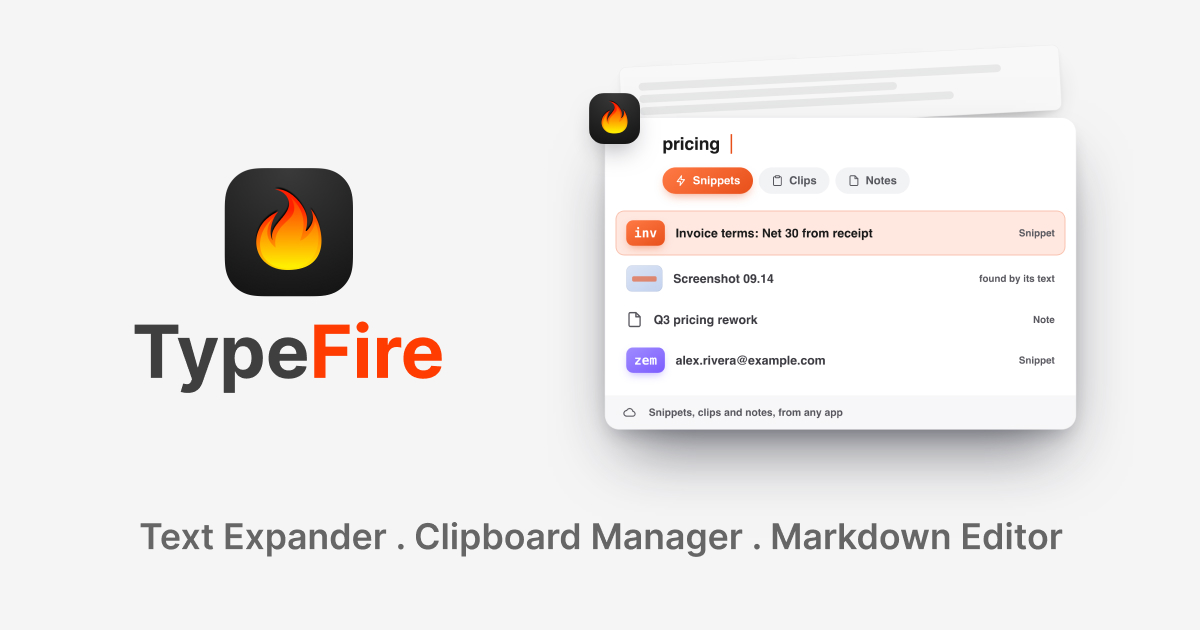
TypeFire runs both halves in the same app, so promoting is a right-click: choose Save as snippet, give it an abbreviation, done. The clip moves out of your rolling history and into your permanent library.
This is not a packaging convenience. A clipboard manager structurally cannot offer it, because it has no snippet engine to promote into. A text expander cannot offer it either, because it never sees your clipboard. TypeFire was a text expander first, which is the only reason the loop closes.
Choosing abbreviations that do not misfire
Once you start promoting things, the abbreviation matters more than people expect:
- Use a prefix you would never type by accident.
zand;are good, because almost no English word starts withzfollowed by more letters you would type deliberately, and;is rarely followed immediately by letters. - Keep them short but not one letter. Three to five characters is the sweet spot.
- Make them describe the content, not the category.
zsupfor a support reply beatszs1. - Set expansion to wait for a delimiter if you work in a terminal or an editor with autocomplete, so nothing fires mid-word.
What to promote first
If you want a quick win, promote these:
- Your email address and phone number
- Your full signature block
- The two or three replies you send most often
- Your address
- Anything you have already searched clipboard history for this week
That list usually covers most of the friction, and takes about ten minutes.
Try it
TypeFire's text expander is free and uncapped, so promoting clips costs nothing regardless of how many you create. The clipboard manager is free at your 10 most recent clips.
Download for Mac or read more about why both halves belong together.
Loved by people who type all day.
Unprompted reactions from users, in their own words.
Used by people at
Company names are places where our users work. They do not imply endorsement or affiliation.