Mac Clipboard Managers That Handle Images Properly
If your work involves screenshots, most clipboard managers quietly fail you. They keep the image, show you a thumbnail, and then offer no way to find it again.
The difference between storing images and handling them properly comes down to three things.
1. Does it keep them at all?
Some managers are text-only by design. Flycut is the clearest example: a paste buffer for developers that deliberately does not touch images. That is a legitimate choice, and it is a dealbreaker if you screenshot constantly.
Most others do store images, so this is the easy bar to clear.
2. Can you find them later?
This is where nearly everything falls over.
A screenshot in your history is labeled something like [Image 900x560]. Two weeks later you remember it contained the phrase "annual contract value" and there is nothing to search. The image is present and effectively invisible.
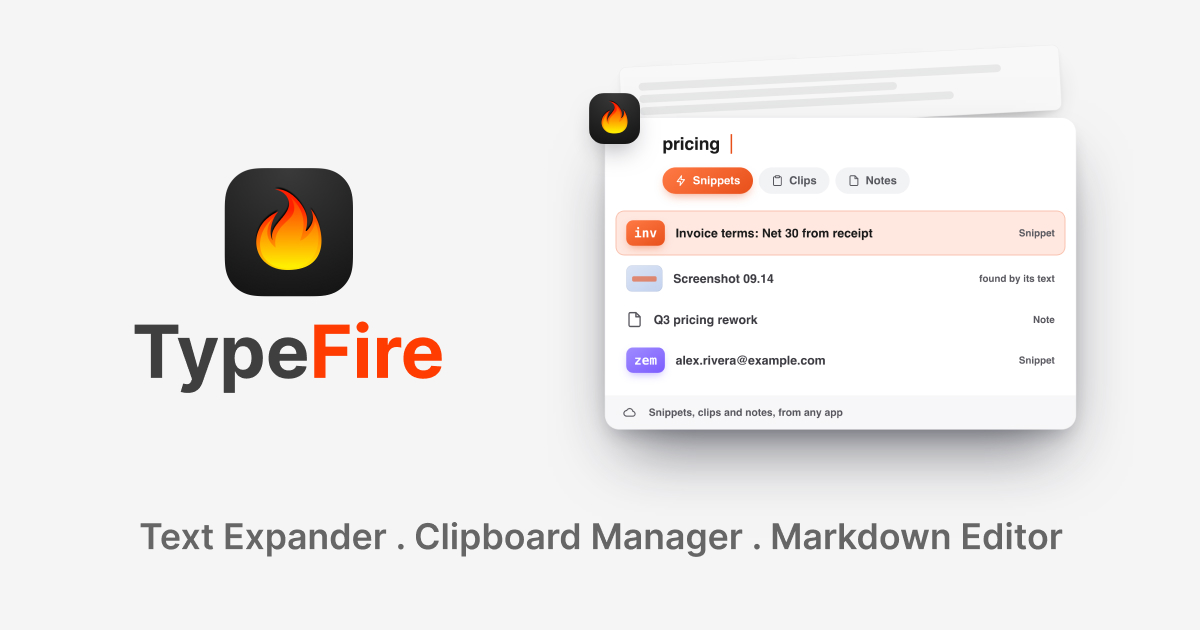
Solving this requires OCR at capture: reading the text inside the image when it arrives and indexing it. Of the twelve Mac clipboard managers in our comparison, only three do this. TypeFire is the only one offering it on a free tier, using Apple's on-device text recognition, so it works offline and costs nothing per image.
The second-best fix, if your manager supports it, is renaming. Turning [Image 900x560] into "Q3 pricing table" makes it searchable by that name. It relies on you remembering to do it, which is worth less than automatic recognition but better than nothing.
3. Does it handle the other visual types?
Images are not the only non-text thing you copy:
- Colors. A good manager shows a swatch and converts to HEX, RGB, HSL or CMYK, which saves a trip to a color picker.
- Files. Keeping the reference so you can open it or copy its path, rather than a filename string.
- Rich text and HTML. Preserving formatting when you want it, and pasting as plain text when you do not.
If you work in design, the color handling alone changes the daily experience.
Practical things to check
Thumbnail quality and size options. Scanning a grid of screenshots only works if they are large enough to recognize. Three thumbnail sizes and a grid view beat a list of tiny previews.
Storage growth. Images are the reason clipboard history gets big. Look for retention by disk budget, not just by count or age, so you can say "never use more than 500MB" and stop thinking about it.
Where the images live. Images are usually stored as separate files alongside the database rather than inside it. Check they are not world-readable. In TypeFire, images sit beside an encrypted database and only your own account can read them.
Filtering by type. Being able to show only images, or only screenshots, cuts a long history down instantly.
The workflow this unlocks
Once screenshots are searchable, clipboard history stops being a paste buffer and becomes a short-term visual memory.
You screenshot an error on Tuesday without naming or filing it. On Friday you search a phrase from the error and it comes back. You never made a decision about where to put it, which is the point: filing systems fail because they require a decision at the moment you are busiest.
Try it
TypeFire's clipboard manager keeps text, rich text, images, screenshots, files, links and colors, reads the words inside every image on your Mac, and is free at your 10 most recent clips with OCR included.
Download for Mac or read about searching text inside screenshots.
Loved by people who type all day.
Unprompted reactions from users, in their own words.
Used by people at
Company names are places where our users work. They do not imply endorsement or affiliation.